Grok Bot vs Hermes: Should We Switch?

Start with the job you want to finish. If the obstacle is keeping a remote computer available and logged into the right services, Grok Bot removes a substantial setup task. If the obstacle is controlling the model, persistent instructions, or the cost of recurring work, Hermes gives you more settings to manage those choices.
You can also use Grok Bot to operate an existing Hermes setup. That is useful only when the handoff has a clear purpose. Paying for two products and maintaining a connection between them is extra work unless it reduces a larger burden.
Use a small evaluation: connect one service, define a task with checkable output, prepare a separate Hermes profile if needed, and verify a repeat run before moving daily work. The examples draw on Superbash’s use of both tools. Current UI and command details were checked against official documentation on October 28, 2026; the trial below is a proposed exercise, not a newly measured comparison.
Choose the first task by its main obstacle
Use a task that produces something you can open and inspect. A local daily report, a draft assembled from supplied documents, or a browser task in an account you control makes a better trial than “run my business.”
| Your main requirement | Starting point | What to verify |
|---|---|---|
| A persistent computer without arranging your own host | Grok Bot | The account connection works and the task continues without your laptop |
| A specific model or provider for recurring work | Hermes | The selected profile actually uses the intended configuration |
| Repeatable instructions you can inspect and edit | Hermes | The next run reads the saved procedure |
| Convenient interaction plus an existing configurable worker | A limited Grok Bot-to-Hermes handoff | The worker performs the task and returns evidence without duplicate execution |
| A new software build or complex video edit | Compare a specialist coding tool on that job | The artifact passes its own checks, regardless of which assistant initiated it |
Ron preferred Grok Bot’s hosted computer after roughly two months of heavy use with Instagram, Gmail, and TradingView. He did not want a portable MacBook to become infrastructure that had to remain online. Hermes could participate in comparable work, but arranging the remote machine, viewer, and access created administration he wanted to avoid. Source: hosted-computer preference, 0:35.
That makes convenience a legitimate reason to choose a tool. It does not establish that one model is better at every task.
Before you start: connect one service and inspect where the work runs
For the Grok Bot trial, use an account you are authorized to connect. Prefer a supported app connection for structured service access; use the browser when the task requires its interface.
The current official steps are to open Connect apps in the sidebar, add the service, complete Authorize or Authenticate, and confirm it appears under Installed. Attach the app to the task with @. An installed app can still need authentication, so check for Needs auth or Disconnected before assigning work. To inspect browser activity, open the computer preview in the conversation’s right-hand panel. Grok Bot computer and apps documentation.
Assign a harmless inspection task first, such as finding a document you identify without modifying or sending it. Confirm the result refers to the correct account and file. Only then give it the trial task.
The hosted computer can continue working while your laptop is closed. Your phone still needs connectivity to send a new instruction. Also, the current docs specify one shared cloud computer per user account: Bots share its files, browser sessions, and command-line credentials, even though their screens differ. A second Bot is not a separate security boundary. Official computer behavior.
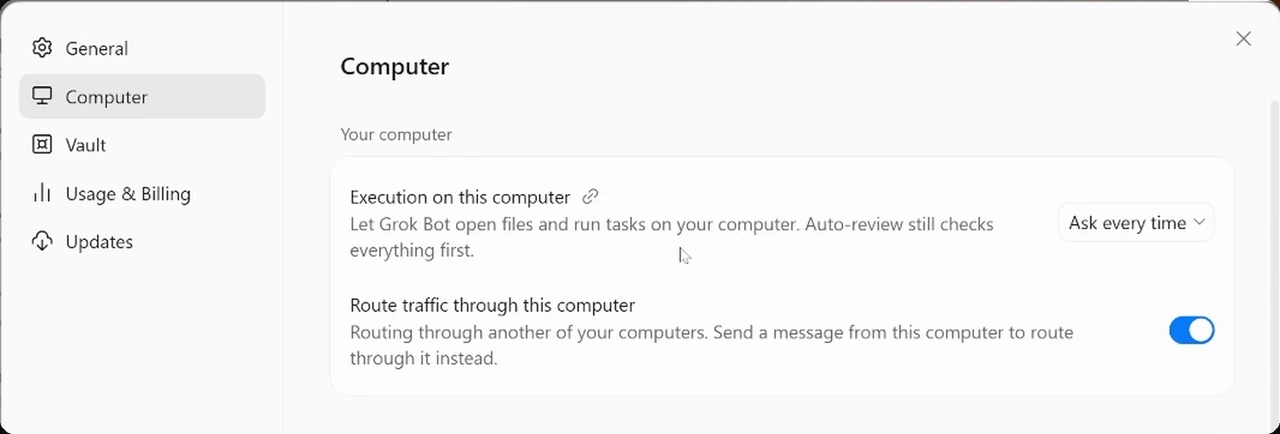
In the current interface, the account menu opens Settings, where Computer distinguishes local devices from the Bot’s cloud computer. The docs also confirm that Grok Bot manages model selection without a model picker. Settings vary by rollout, so use the labels present in your account rather than assuming the recording’s layout is permanent. Grok Bot settings.
Define completion before comparing speed
Give both tools the same input and acceptance criteria. Avoid a task whose success is only “the agent sounded confident.”
For a report built from local input files, use a brief like this:
Read the supplied input documents and create a report for review.
For every conclusion, identify the source file and relevant passage.
List missing or conflicting information instead of filling it in.
Save the report in the agreed output folder and give me its exact path.
Do not email, publish, or overwrite the source documents.
Finish by listing the checks you performed and any unresolved issues.
This is an example task specification, not a special command. Prepare the same source documents for each trial. Record start time, output time, interruptions that needed you, and the corrections you made after reading the output.
Superbash’s preference for Grok Bot partly reflects fewer interruptions between the request and action. The team found some GPT-powered Hermes interactions more insistent about pausing, particularly around API credentials. One example involved a key described as having a $1 daily allowance; Michael estimated that the resulting interruption cost him five or six minutes. That was his recollection, not a measured comparison of task times. That is evidence of the friction they experienced, not evidence that a small spending cap prevents every consequence of exposing a credential. Source: execution and interruptions, 2:29.
Use the product’s credential-entry mechanism for the trial. Current Grok Bot documentation describes Vault and secure sign-in forms, and secure secret cards for API keys. Keep credentials out of ordinary task text. This lets you compare the work rather than repeatedly repairing the way access was supplied. Official Vault guidance.
Hermes behavior also depends on its selected model and instructions. Record that configuration next to the result. A frustrating response from one model in Hermes does not establish a fixed behavior of the harness.
Separate executing a test from inventing a better idea
An agent can carry out a precise procedure quickly and still be weak at deciding whether the procedure is useful. Evaluate those responsibilities separately.
Ron’s TradingView experience is a concrete example. He supplied strategies, parameters, and combinations and found Grok Bot quick at running backtests. He was less satisfied when he wanted it to think beyond those inputs and devise a stronger approach. He also acknowledged that a strategy without an edge remains a weak starting point even if it is tested efficiently. The source reports no verified profitable strategy or trading return. Source: execution versus reasoning, 4:12.
Apply that distinction to a nonfinancial trial too. First ask whether the tool followed the procedure and used the correct inputs. Then assess a separate request to critique the procedure, identify assumptions, or propose a different approach. If you mix those into one vague instruction, a fast but literal result can look like success until you try to use it.
A useful critique prompt is: “Identify which assumptions in this report are supported by the supplied files, which are uncertain, and what additional evidence would change the conclusion.” Judge its answer against the sources, not against how sophisticated the wording sounds.
Save the method so the second run can find it
After the first successful trial, save the accepted procedure and the location of its inputs. Include any exception that mattered. Then start a later task that requires the same method and check whether the agent retrieves it without being coached through every step.
Ron reports teaching Grok Bot a TradingView bar-replay technique, then having to remind it several days later. The agent eventually found the earlier Python script. This shows a reuse failure in that workflow: useful material existed, but the next task did not apply it until prompted. The reported 20,000-candle limit and replay workaround are specific to that account and task; this guide does not treat them as a current universal TradingView instruction. Source: method reuse, 6:52.
For the report exercise, ask the agent to name the procedure file it used and explain any departure from it. If it cannot locate the method, supply the path and fix how future jobs discover it. Do not accept “I will remember” as the only storage mechanism.
The team values Hermes because it can inspect and edit configuration and persistent instructions. That makes a missing rule easier to locate. It does not make every remembered rule correct, and it does not guarantee that a model will follow it. Test the second run against the same acceptance criteria.
The hosts suspect crowded context contributes to Grok Bot’s failures, but the source supplies no context trace proving that explanation. Their speculation about which Grok model was active is also not routing evidence. The observable problem is that a task failed to reuse a known method.
Prepare a separate Hermes profile for recurring work
If you already have Hermes installed, make the trial’s configuration distinct from your existing assistant. Current Hermes profiles keep their own configuration, credentials, memories, sessions, skills, and job state. Do not run two independent agents against the same profile home. Official profile guide.
The documented profile workflow is:
hermes profile create routine-trial
hermes -p routine-trial setup
hermes -p routine-trial chat
Choose the provider and model during setup, then give this profile the same report exercise. The expected result is a separate worker whose settings and output you can identify. A profile is a state boundary within Hermes; it does not automatically give the worker a separate operating-system account or a separate Grok Bot computer.
This is a test profile for readers with an existing Hermes installation, not a complete server or Grok Bot integration install. If you need the initial assistant setup, use the Hermes learning path before adding a second product.
Once the interactive task succeeds, ask Hermes to prepare one scheduled test of the same work. Specify the exact input directory, output directory, timezone, run time, and local delivery. Request a readback of the saved job before letting it become a daily routine. Use a single test occurrence first so a mistaken schedule cannot keep producing work unnoticed.
Inspect the trial profile’s jobs and scheduler:
hermes -p routine-trial cron list
hermes -p routine-trial cron status
Hermes scheduled agent jobs run through its gateway. A saved job is not enough if the responsible gateway is unavailable. Current cron documentation distinguishes per-job model pins, a cron default, and the main agent model; verify which one the job will use instead of assuming it inherits the last conversation’s choice. Hermes scheduled tasks.
Wait for the test to run, open its output, and compare it with the interactive result. Check that no second scheduler created another copy. Only then replace a recurring task elsewhere.
Add the Grok Bot handoff when it has a defined benefit
The Superbash arrangement assigns different work to each layer. Grok Bot provides convenient interaction and helps maintain Hermes, including updates and profile configuration. Hermes performs routine work and scheduled jobs using the selected model access. The team describes giving its Grok Bots Hermes profiles they can operate. Source: combined workflow, 8:33.
A useful handoff names the profile, task, allowed changes, and required evidence:
Use the routine-trial Hermes profile for the report task.
Confirm the profile and its existing job before starting anything.
Do not create a duplicate schedule or change the selected model.
Return the completed report path, the job's status, and any failure.
If a run is already active, report its status instead of starting another.
This example assumes an authorized connection to the machine running Hermes already exists. The source does not publish the connection method, credentials, or complete permission settings. Do not infer those details from a successful chat. Have the agent identify the host and profile it can reach, run the small test, and show the worker’s output before assigning maintenance or recurring production work.
If Grok Bot updates Hermes, require it to check the version and rerun the trial afterward. The team reports updates hanging or needing small repairs in its own installation; that is a reason to verify a maintenance result, not a universal failure rate for Hermes updates.
Measure the cost of the complete arrangement
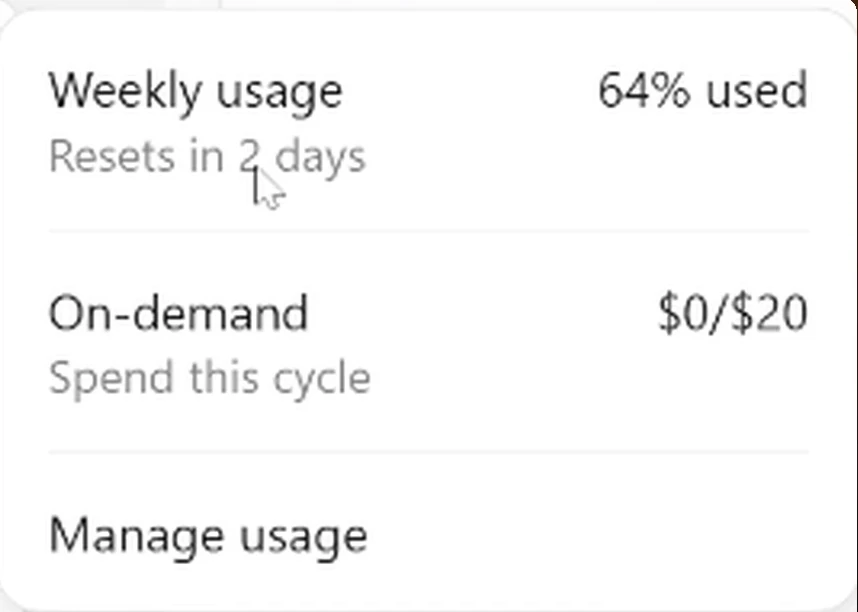
Record Grok Bot usage before and after the trial, the worker’s provider usage where available, and the time you spent intervening. If unrelated jobs run during the measurement, record that too. You cannot attribute the whole change in a weekly allowance to one task unless the other activity is accounted for.
Hermes lets the team choose among model access options it already uses, including OpenAI, MiniMax, flash models, and DeepSeek. That flexibility is the basis of its cost argument. Model choice still has to satisfy the task: a low-cost run that needs extensive rewriting may not be cheaper in practice.
The team reports that delegating recurring execution to Hermes reduces its Grok usage, but provides no before-and-after totals or complete bill. Grok Bot still has a cost, Hermes still needs model access and a host, and coordination itself can consume usage. The source explicitly acknowledges the objection that buying both products can be expensive. Source: routine-work economics, 9:56–11:05.
Keep the combined setup if the saved work and usable outputs justify it. If one product already completes the task with acceptable effort and cost, the trial gives you no reason to add the other.
Troubleshoot the result after the conversation ends
A network setup that works once can still have a permission or persistence problem. The team reports one setup that claimed completion and failed a couple of days later. It did not establish a measured hallucination rate or isolate the precise cause. Source: reliability example, 5:49.
For your trial, perform the actual action the setup was meant to enable. Open the saved report from its returned path. Verify the next scheduled execution. Check access from the intended host rather than from a different machine where credentials happen to work. If the agent says a job is complete but supplies no artifact or status record, ask for that evidence before moving on.
If a browser login expires, complete the normal sign-in flow and rerun the small inspection task. If a schedule disappears, inspect the selected profile before recreating it. If a worker is already running, inspect it before submitting again. A cloud-computer reset is a recovery control mentioned by the team, but it is not a substitute for identifying what state or files need preserving.
Software builds and video edits may still belong in another tool. Superbash prefers Codex for some building work and Claude Code for video editing, while using Grok Bot for daily operations. Its comments about Cursor being the default building path describe its observed workflow, not a guaranteed current routing or billing rule. Those preferences support assigning tools by job rather than forcing one assistant to perform everything. Source: specialist tools, 11:05.
Choose the arrangement that completes your representative task, reuses the saved method, and survives the next run with a result you can inspect. The Pi specialist-worker guide applies the same division of responsibility when several recurring tasks need their own operators.