Tencent WorkBuddy · Tutorial 07
Research, Sources, and Knowledge in WorkBuddy
Create a source ledger, separate discovery from evidence, write a cited brief, and save durable knowledge without preserving weak claims.

0 of 7 complete
Essentials · Step 7 of 7 · View the route
Last checked and updated: September 3, 2026
WorkBuddy can search, analyse, create briefs, and save useful results into its Library or an ima knowledge base. A strong workflow preserves the path from each claim to the exact source. A list of links at the end is not enough if nobody can tell which link supports which sentence.
Begin with a research contract
Question: Which three AI meeting-note tools currently support Traditional Chinese transcription?
As-of date: September 3, 2026.
Allowed evidence: official product, help, pricing, privacy, and status pages.
Discovery only: directories, search snippets, social posts, and reseller pages.
Output: a claim ledger, comparison table, and 600-word decision brief.
Stop: do not create accounts, upload recordings, start trials, or contact vendors.
The as-of date matters because features and pricing change. “Currently” without a date is not reproducible.
Build the claim ledger first
Ask WorkBuddy to create source-ledger.csv:
| Field | Meaning |
|---|---|
| claim_id | Stable identifier used in the brief |
| claim | One precise statement |
| source_url | Direct page supporting it |
| publisher | Organisation responsible for the page |
| published_or_updated | Date when available |
| checked_at | Your research date and timezone |
| evidence_status | confirmed, partial, conflicting, unavailable |
| note | What the page proves and does not prove |
Require a direct supporting page, not a search-results URL. If a pricing table is visible only after login, mark it unavailable instead of guessing from a snippet.
Use a two-pass process
Pass 1: discovery
Collect candidate products, terms, and source pages. Do not write the recommendation yet.
Pass 2: verification
Open primary sources, update the ledger, and remove unsupported claims. Ask WorkBuddy to quote only a short identifying phrase when necessary and otherwise paraphrase.
Use this verification prompt:
For each row, open the direct source and decide whether it proves the whole claim.
If only part is supported, split the claim.
If two official pages disagree, preserve both with dates and mark conflicting.
Do not convert absence of evidence into “no.” Use unavailable or not found.
Write from the ledger
Write the brief using only confirmed or clearly labelled partial rows in source-ledger.csv.
Append claim IDs in parentheses to factual sentences.
Separate vendor claims, our calculations, and our recommendation.
Include a “What we could not verify” section.
Review every claim ID against the ledger. Then remove mechanical IDs from reader-facing prose only if the final format provides equally direct links beside the claim.
Save knowledge selectively
WorkBuddy’s Library can hold MD, CSV, HTML, office files, images, audio, and video. Official documentation says people and agents can continue working on stored content, and AI edits to Markdown can be held for acceptance before they replace the body. WorkBuddy can also send useful outputs to ima knowledge bases.
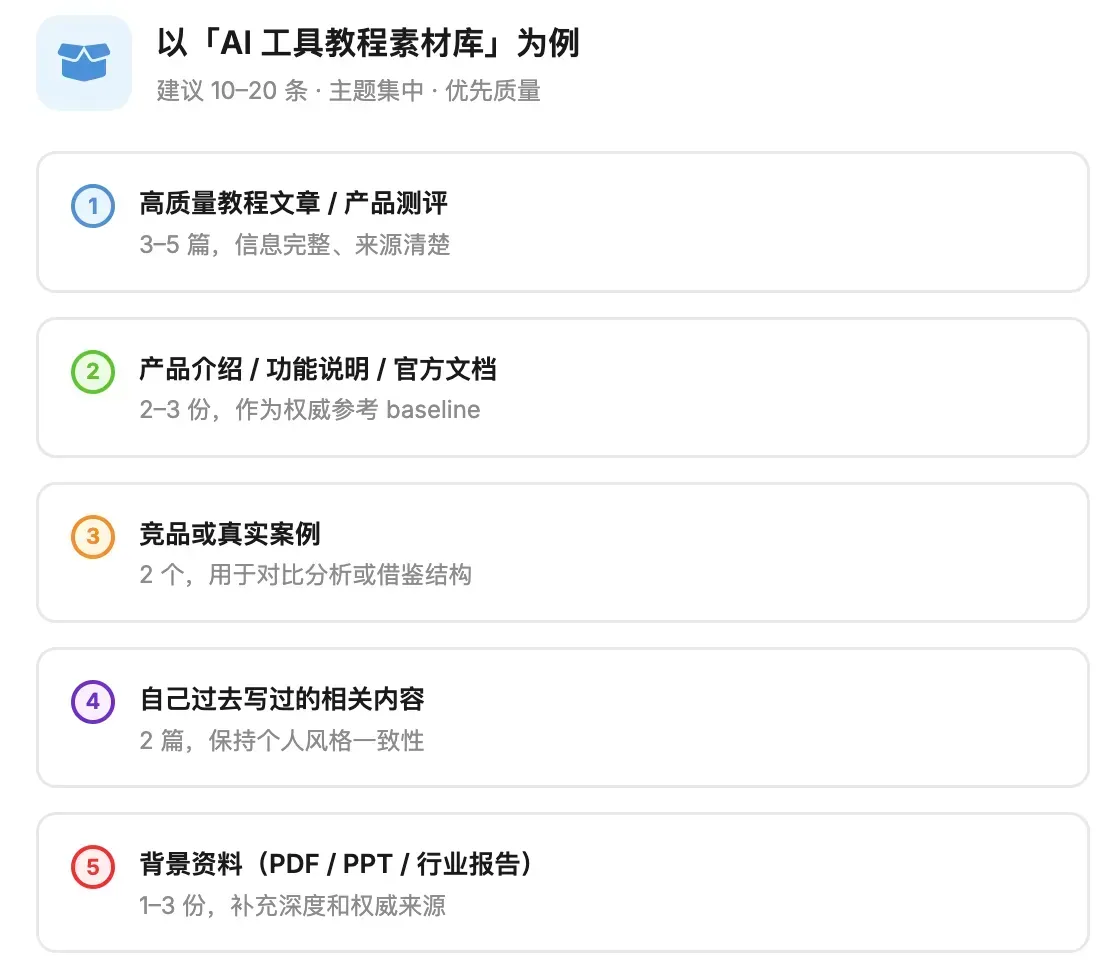
Use three folders:
Sources/for captured links and original evidence notes.Reviewed/for approved ledgers and briefs.Methods/for the research contract and reusable checklist.
Do not save an unreviewed draft into the same place as approved research. Retrieval can surface both later without understanding your editorial status.
Knowledge-base maintenance
Add metadata to each durable item:
Status: reviewed
Owner: [person]
Checked: 2026-09-03 Asia/Hong_Kong
Scope: [question answered]
Expires or recheck: [date or trigger]
Supersedes: [older item, if any]
The official ima guide recommends building a knowledge base around a clear task rather than one “everything” collection. That makes retrieval more precise and stale content easier to retire.
Success check
Select three factual sentences from the final brief. Another person must be able to open the direct source, see exactly what supports each sentence, and understand any inference or uncertainty.
FAQ
Is a web directory a source?
It is useful for discovery. It is weak proof for a vendor’s current capability, price, privacy practice, or availability unless the directory itself is the fact being studied.
Does saving a result to a knowledge base make it true?
No. Storage increases reuse, including reuse of errors. Save status, dates, provenance, and review ownership.
Does Library storage cost credits?
Official Library documentation says storage, organisation, retrieval, and manual editing do not consume credits; using WorkBuddy to analyse, generate, or revise content does.
Quick self-check
Q1. A product appears in three directories but no official page confirms the feature. What status should the claim receive?
Answer: Unavailable or unconfirmed; the directories remain discovery evidence only.
Official sources
What’s next
Turn a reviewed brief into a deck or webpage without accidentally publishing it in L08: Presentations, Design, and Publishing.