Hermes Agent · Tutorial 03
Hermes Agent TUI vs Desktop App
Choose between the Hermes TUI and Desktop App for each task. They run the same agent and share state, so you can also use both.

0 of 8 complete
Essentials · Step 3 of 8 · View the route
Last tested and updated: June 2026
The TUI and Desktop App are two windows into the same Hermes back end. You can keep both open and switch between them without losing the session.
After L02: How to Install Hermes Agent for Beginners, you ran your first sessions in the TUI. Hermes added a native Desktop App in June 2026, giving the same agent a second interface.
One agent, two interfaces
The TUI and Desktop App share the same Hermes back end, including configuration, profiles, Skill Bundles, model, memory, and session state. You can switch mid-task without starting over.
The differences are entirely in the surface: what each interface is good at showing and asking you to do.
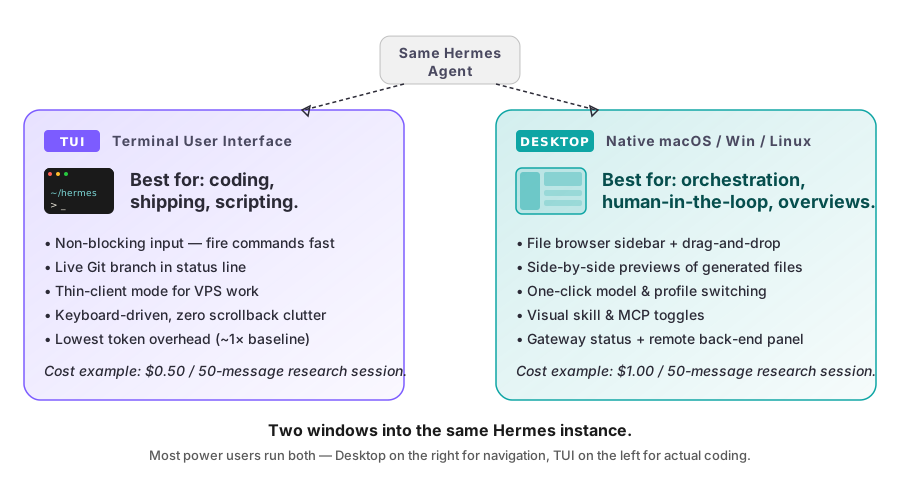
Think of the agent as the kitchen. The TUI is the line cook’s station: fast, knife-ready, every tool within reach. The Desktop App is the head chef’s pass. Same kitchen. Different vantage points.
The TUI is the original Hermes interface. It is keyboard driven, runs in any terminal, and sends only raw text to the model. Terminal-native developers also get the live Git branch in the status line, non-blocking input, and thin-client mode for a VPS.
The Desktop App is a native Electron + React app that ships with v0.16 “Surface” (June 2026). It adds features the TUI cannot render: a file-browser sidebar, side-by-side previews, drag-and-drop upload, and a one-click model switcher.
One thing you should know up front. The Desktop App costs roughly 2× more tokens per message than the TUI. Every Desktop message includes UI schemas, layout state, and background file-scanning data. The TUI sends just your text. Same model, same answer, more context billed.
You pay your own API bill. Hermes is BYOK (Bring Your Own Key) from L01. A 3am runaway Desktop session can burn real money overnight. The official docs don’t advertise it. The source video does.
Match the interface to the work
Match the surface to the work. Open the TUI for coding. Open the Desktop App for orchestration and review. The decision rule has three questions:
- Am I writing code, or managing projects? Writing code → TUI. Managing projects → Desktop App.
- Do I need to see state (files, models, status) without typing? Yes → Desktop App.
- Am I doing this from a VPS over SSH? Yes → TUI. The Desktop App can connect to a remote back-end, but the setup is non-trivial; start with the TUI on the VPS first.
Here’s the same rule in table form:
| Workload | TUI | Desktop App | Why |
|---|---|---|---|
| Coding / shipping features and refactors | Best choice | Token-heavy | TUI’s lower overhead saves real money on long sessions |
| Quick question or chat | Fine | Fine | Either works for low volume |
| Reviewing overnight agent activity | Requires CLI commands | Best choice | Desktop App’s project overview is built for this |
| Switching models | Requires hermes model | One click | Visual model picker |
| Drag-and-drop a file | Type the path | Best choice | Desktop UX |
| Human-in-the-loop workflows | Cumbersome | Best choice | Visual feedback is built for this |
A few things to keep in mind:
- MCPs are still rough in the Desktop App as of v0.16. Discoverability and toggling for MCP integrations work better in the TUI today.
- Bugs are usually back-end bugs. If a bug shows up in the Desktop App, check the TUI first to confirm: they share a back-end.
For the deeper comparison once you’ve tried both, see L09: Hermes Agent vs Claude Code vs Mavis.
Compare both interfaces
The exercise
You need two interfaces open at once for this one. If you haven’t installed the Desktop App yet, get it from the same place you got the TUI in L02.
- Open the TUI and ask Hermes to summarise a local file such as a notes file, configuration file, or README.
- Open the Desktop App. Connect to the same Hermes instance. Open the same session.
- Send one message from the TUI. Note the token count or rough cost.
- Send the same message from the Desktop App. Note the token count or rough cost.
- Spend 30 minutes using both. Try the file browser sidebar and the model switcher in the Desktop App. Try the Git branch status line and rapid-fire commands in the TUI.
- Switch back and forth. Notice that the current conversation, memory, and profile follow you.
A good outcome is one sentence in your own words answering all three of these without re-reading the lesson:
For (a) refactoring a 200-line function, (b) reviewing what three different agents did overnight, and (c) running an MCP-heavy workflow, which interface do I open first, and why?
Watch the full breakdown
If you’d rather hear the morning-meeting framing from Ron directly, here’s the 9-minute source clip:
What’s next
- Want to teach Hermes to do specific things? → L04: Hermes Agent Skills and Skill Bundles Explained.
- Still wondering whether to use Hermes at all? → L09: Hermes Agent vs Claude Code vs Mavis is the deeper comparison once you’ve tried the basics.