Brief 24 · Prompt edition 2.1
Wrecklight Salvage
Build a playable three-phase salvage game in one HTML document: pilot a small tug through a wreck, power a reactor vault with two recovered cells, then tow the physical reactor through an extraction gate and settle it in a dock to win.
Read the complete prompt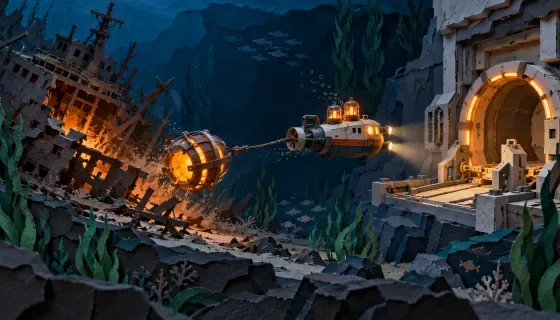
4 recorded evaluations of this frozen brief · artifacts published unedited
Recorded evaluations
Each artifact was produced against edition 2.1 of this brief and is published exactly as delivered. The model run page links the run record, which states which source-level checks were performed, which checks remain for a human browser review, and how this delivery differs from a hosted-API single-message episode.
- Claude Fable 5.2 claude-fable-5-2Open artifact
- GPT-6.1 Terra gpt-6.1-terraOpen artifact
- Kimi K3.1 Pro k3.1-proOpen artifact
- MiniMax M3.1 Flash MiniMax-M3.1-FlashOpen artifact
What this tests
three-phase game progression with persistent physical cargo and a visible late-stage consequence.
Proposed difficulty
Combines Starfall's progression and Ember Glider's movement with persistent world changes, coupled towing, and an extraction check that depends on the object collected earlier.
These are design hypotheses, not observations of model failure. Empirical discrimination has not been measured.
One message, one HTML response
Give each model the exact complete prompt as one user message. It returns one self-contained HTML document in one response, without tools, external assets, dependencies or follow-up repair. Mental validation is not runtime evidence; the operator performs the actual offline browser checklist afterward.
Do not append BENCHMARK-PROMPT.md to this brief.
Rubric and pass rules
Five binary observations per brief, with no numeric scores or rubric weights. Pass only when every criterion and the offline single-document protocol are observed. Untested checks remain not-observed. Inspect at 1280×720 and a narrow viewport; retain uncut evidence and separate aesthetic preferences from functional observations.
- G1: earned restoration
- Two distinct cell deliveries visibly open vault Fail: Timer unlock, duplicate cell, unchanged world
- G2: real recovery
- Same reactor trails, collides, detaches, reattaches; its crossing gates Phase 3 Fail: Decorative tether, swapped object, tug-only transition
- G3: late gate
- Cargo-triggered cycle physically blocks and safely drains; state/countdown agree Fail: Cosmetic shutter, clipping, crushing, severed cable
- G4: truthful extraction
- Tug-only/partial/attached entry rejected; detached stable cargo earns victory Fail: Victory triggered by phase timer or tug location
- G5: persistence and review
- Normal progression and labeled fixture use shared rules; pause/reset work Fail: Review bypasses collision, fake progression, stale state
Pass: Pass requires G1–G5 and the offline single-document protocol. A fixture pass alone cannot establish G1, G2, or normal-run persistence. Complete and record one ordinary start-to-finish run as well as the fixture check; log duration rather than inventing a score. The 2–4-minute target guides pacing, not a speed leaderboard.
Controls and reviewer sequence
- WASD/arrows: accelerate; Space/Interact: pick up, install, attach or release. Holdable directional buttons are required.
- Pause freezes physics and timers. Reset returns to Phase 1. Review: Phase 3 loads a labeled fixture, never an earned run.
Use the labeled review fixture for identical 20–30-second late-game comparisons. Separately show a brief montage from each actual full run proving both deliveries and reactor recovery. Label fixture footage explicitly; failures to reach late game ordinarily remain failures even if the fixture looks excellent.
Review beyond the examples
Take a different cell first, release cargo before the threshold, pause near gate closure, tow the tug into the dock while cargo remains outside, and detach partly outside the dock. Inspect source for a single shared update path used by the review fixture and ordinary play. A stage label or scripted victory sequence is not progression.
Versions and prompt revisions
Superbench 2.1 combines four new v21 contracts with Ember Glider and Low-Poly Tower Defense as returning 1.x briefs. The returning prompts and their existing artifacts keep their original repository-run protocol; they are not relabeled as tool-free 2.1 generations. Superbench 2.0 retains v2, while the remaining 1.x core, specialist and archived results retain their original protocols. No historical scores are migrated or compared quantitatively across editions.
Edition 2.1 is the launch contract. Changes to behavior, fixtures or pass criteria require a new documented edition; future evaluations must retain the exact evaluated prompt revision. Typographic corrections must be identified.