Brief 21 · Prompt edition 2.1
Skyhook Cargo
Build a playable harbor crane challenge in one HTML document: move a suspended cargo crate around a solid tower and settle it onto a marked pad, with visible pendulum physics and telemetry that agrees with the scene.
Read the complete prompt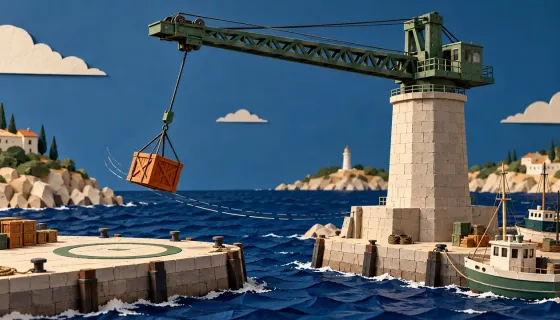
4 recorded evaluations of this frozen brief · artifacts published unedited
Recorded evaluations
Each artifact was produced against edition 2.1 of this brief and is published exactly as delivered. The model run page links the run record, which states which source-level checks were performed, which checks remain for a human browser review, and how this delivery differs from a hosted-API single-message episode.
- Claude Fable 5.2 claude-fable-5-2Open artifact
- GPT-6.1 Terra gpt-6.1-terraOpen artifact
- Kimi K3.1 Pro k3.1-proOpen artifact
- MiniMax M3.1 Flash MiniMax-M3.1-FlashOpen artifact
What this tests
suspended-load physics, solid contact, and truthful telemetry.
Proposed difficulty
Extends the coupled machinery of Stormwind and motion control of Neon Drift with a moving suspension point, variable cable length, persistent contact, and state-derived completion.
These are design hypotheses, not observations of model failure. Empirical discrimination has not been measured.
One message, one HTML response
Give each model the exact complete prompt as one user message. It returns one self-contained HTML document in one response, without tools, external assets, dependencies or follow-up repair. Mental validation is not runtime evidence; the operator performs the actual offline browser checklist afterward.
Do not append BENCHMARK-PROMPT.md to this brief.
Rubric and pass rules
Five binary observations per brief, with no numeric scores or rubric weights. Pass only when every criterion and the offline single-document protocol are observed. Untested checks remain not-observed. Inspect at 1280×720 and a narrow viewport; retain uncut evidence and separate aesthetic preferences from functional observations.
- C1: inertia
- Release leaves visible swing; reversal changes it continuously Fail: Rigid attachment, canned oscillation, snapping
- C2: geometry
- Cable stays constrained; crate and cable respect tower; crate rests on surfaces Fail: Stretch, tunneling, clipping, embedded load
- C3: HUD truth
- Angle arc/readout match positions; speed and contact follow scene Fail: Independent counters or contradictory status
- C4: actual landing
- Partial/fast entry rejected; stable full-footprint contact earns two-second completion Fail: Proximity, elapsed time, or button alone grants success
- C5: usable presentation
- Legible harbor, depth, controls, pause, resize, and repeatable reset Fail: Hidden target, unreadable HUD, broken controls or restart
Pass: Pass requires C1–C5 and the offline single-document protocol. Numerical thresholds are behavior requirements, not model scores. Inspect source to verify telemetry and landing use shared simulation state if video alone is inconclusive.
Controls and reviewer sequence
- Left/Right or A/D: accelerate trolley; release to brake. Up/Down or W/S and Cable ±: hoist/lower.
- Use holdable on-screen controls, Pause and Reset.
Use the same reset and one-second acceleration/release/reverse inputs in every run, followed by a separate successful landing attempt. Show split-screen cable angle and tower contact; caption observed behavior only. Do not imply a full delivery occurred within the opening clip.
Review beyond the examples
Repeat with short and long cables, alternate acceleration durations, approach the pad from both sides, and pause at half a settle ring. An attractive automated demo cannot substitute for manual interaction. No success shortcut is allowed.
Versions and prompt revisions
Superbench 2.1 combines four new v21 contracts with Ember Glider and Low-Poly Tower Defense as returning 1.x briefs. The returning prompts and their existing artifacts keep their original repository-run protocol; they are not relabeled as tool-free 2.1 generations. Superbench 2.0 retains v2, while the remaining 1.x core, specialist and archived results retain their original protocols. No historical scores are migrated or compared quantitatively across editions.
Edition 2.1 is the launch contract. Changes to behavior, fixtures or pass criteria require a new documented edition; future evaluations must retain the exact evaluated prompt revision. Typographic corrections must be identified.