Brief 22 · Prompt edition 2.1
Concourse Divide
Build an interactive station diorama in one HTML document where two opposing crowds visibly reroute around closing gates, queue without crossing walls or one another, and resume when a route reopens.
Read the complete prompt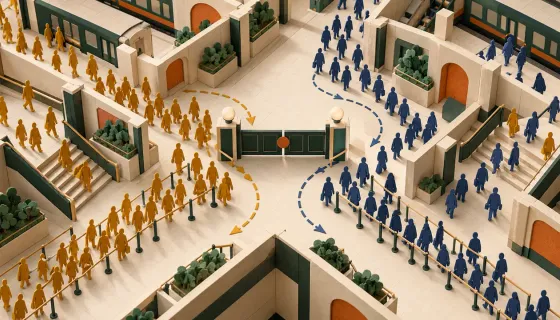
4 recorded evaluations of this frozen brief · artifacts published unedited
Recorded evaluations
Each artifact was produced against edition 2.1 of this brief and is published exactly as delivered. The model run page links the run record, which states which source-level checks were performed, which checks remain for a human browser review, and how this delivery differs from a hosted-API single-message episode.
- Claude Fable 5.2 claude-fable-5-2Open artifact
- GPT-6.1 Terra gpt-6.1-terraOpen artifact
- Kimi K3.1 Pro k3.1-proOpen artifact
- MiniMax M3.1 Flash MiniMax-M3.1-FlashOpen artifact
What this tests
visible agent rerouting, collision avoidance, and recovery from blocked connectivity.
Proposed difficulty
Tower Defense's pathfinding becomes two-way traffic with dynamic topology, finite-radius agents, congestion, and recovery.
These are design hypotheses, not observations of model failure. Empirical discrimination has not been measured.
One message, one HTML response
Give each model the exact complete prompt as one user message. It returns one self-contained HTML document in one response, without tools, external assets, dependencies or follow-up repair. Mental validation is not runtime evidence; the operator performs the actual offline browser checklist afterward.
Do not append BENCHMARK-PROMPT.md to this brief.
Rubric and pass rules
Five binary observations per brief, with no numeric scores or rubric weights. Pass only when every criterion and the offline single-document protocol are observed. Untested checks remain not-observed. Inspect at 1280×720 and a narrow viewport; retain uncut evidence and separate aesthetic preferences from functional observations.
- A1: changing route
- Selected route and crowd visibly divert after closure Fail: Same path through shutter or decorative route overlay
- A2: physical crowd
- Bodies respect walls, gates, and each other; occupied gate drains Fail: Clipping, crushing, teleporting, disappearing
- A3: disconnected state
- Closed network produces safe waiting and truthful No route Fail: Wandering through walls or premature arrival
- A4: recovery
- South-only reopening delivers all 48 within 90 simulation seconds Fail: Permanent jam, timer completion, missing agents
- A5: inspectability
- Stable IDs, trails, counts, seeded reset, pause, usable controls Fail: Counter animation detached from actual population
Pass: Pass requires A1–A5 and the offline single-document protocol. Review full-duration recovery separately from the short editorial clip. Tiny numerical contact jitter is not body-crossing; sustained visible overlap or bodies exchanging sides through each other is a fail.
Controls and reviewer sequence
- Toggle North, Center and South using buttons or the gates. Click an agent to inspect its ID, route and trail.
- Pause freezes motion and trails; Reset restores the same seed and all 48 agents.
Show identical Center closure first, then the all-closed/South-open intervention. Keep selected-agent trails visible. If showing a sped-up drain, label the speed and report actual simulation time; never present a 90-second check as 20 seconds of real time.
Review beyond the examples
Change gate order, select different IDs, toggle occupied gates, and inspect counts after all gates close. Source review must establish geometry-dependent routes and persistent agents rather than a bank of authored gate animations. Gate closure is assessed only after its declared drain state completes.
Versions and prompt revisions
Superbench 2.1 combines four new v21 contracts with Ember Glider and Low-Poly Tower Defense as returning 1.x briefs. The returning prompts and their existing artifacts keep their original repository-run protocol; they are not relabeled as tool-free 2.1 generations. Superbench 2.0 retains v2, while the remaining 1.x core, specialist and archived results retain their original protocols. No historical scores are migrated or compared quantitatively across editions.
Edition 2.1 is the launch contract. Changes to behavior, fixtures or pass criteria require a new documented edition; future evaluations must retain the exact evaluated prompt revision. Typographic corrections must be identified.