Research brief · August 31, 2026
WikiSkill Is Promising Research. The Community CLI Still Needs Your Own Gate
A source-grounded review of the WikiSkill paper and community CLI, including a held-out Hermes evaluation that remains unmeasured rather than overstated.
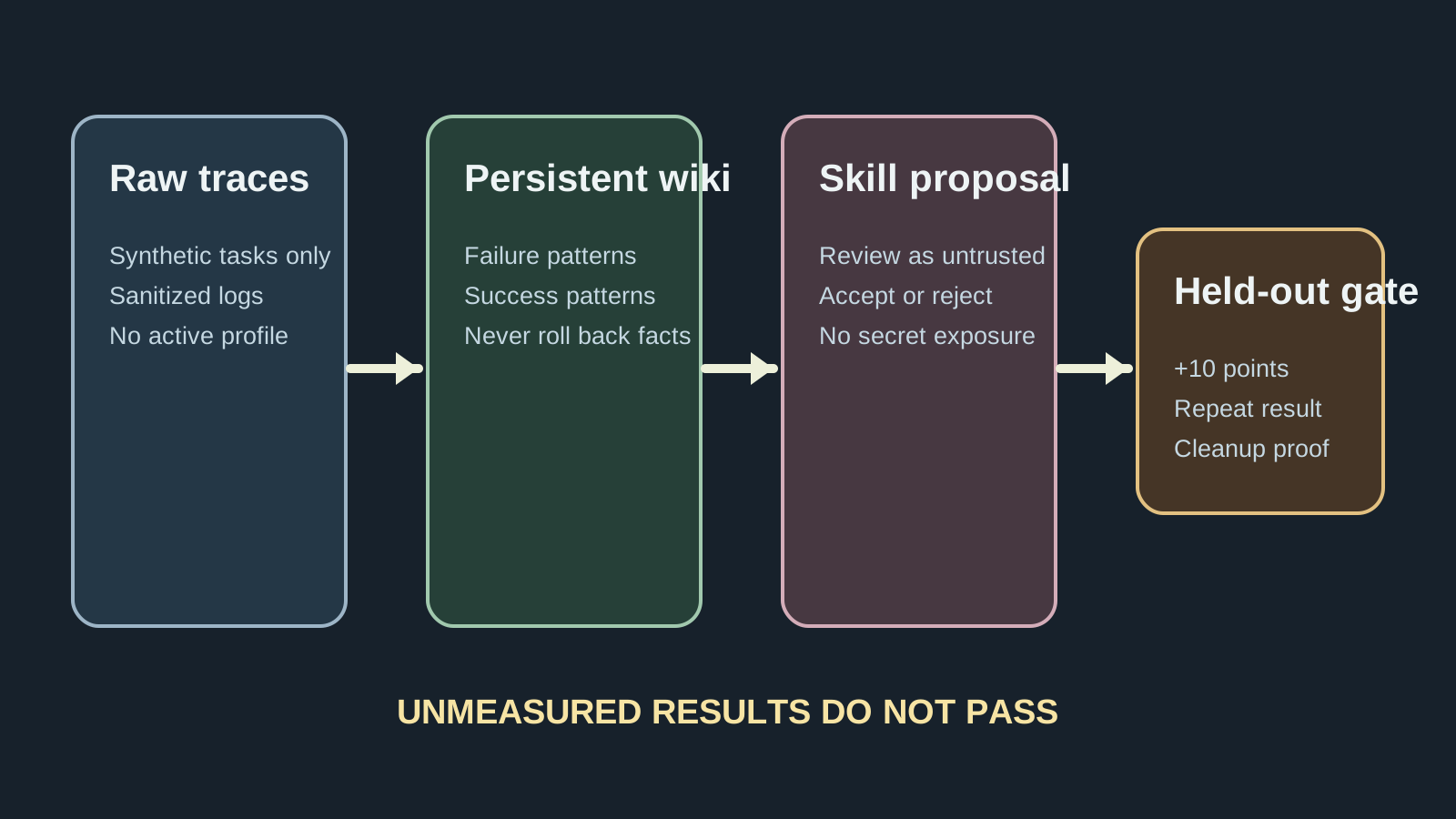
WikiSkill's persistent-wiki idea has encouraging paper results, but those benchmark results do not establish reliability for Superbash editorial or coding work. The reviewed community CLI has a sensible isolation design and a real 0.1.2 repair, yet its Hermes bootstrap copies profile configuration and credentials. Our ten-case held-out harness was not run without a separately provisioned test profile, so the result is unmeasured and no tutorial is published.
WikiSkill is a Google Research framework for turning execution experience into a persistent knowledge base that helps propose agent-skill changes. The paper separates three layers: immutable raw traces, a wiki that retains consolidated patterns, and skills that may be rolled back when validation does not improve.[1] An independent account describes the same raw/wiki/skill division and stresses that the underlying model is not continuously retrained by this process.[4] That is an appealing answer to a familiar agent problem: a useful lesson often disappears with a chat transcript.
It is not a promise that an evolving instruction folder will improve every workflow. The paper evaluates five benchmark families with five models; it reports gains over no-skill and prior skill-evolution baselines in many settings, while also showing that results vary by benchmark and model.[1] An editorial site, a private repository, a tool approval policy, and a real customer workflow are not those benchmarks.
What the community project actually ships
ashutoshsinghpr7/wikiskill is an MIT-licensed Python CLI/application, not a standalone skill package. Its PyPI metadata requires Python 3.10 or later and exposes a wikiskill console command.[2] The application creates workspaces, materializes task sandboxes, preserves traces and a wiki, runs a maintainer and proposer, and gates a candidate skill set against validation tasks.[3]
The pinned artifact reviewed for this article is wikiskill==0.1.2, wheel SHA-256 79d7aa575e8b1f8c6ec4f3598a2aa1873ec6aa54bca524051e05a0ab55f96a2e. PyPI records version 0.1.1 as yanked because wikiskill.backends was missing; 0.1.2 includes that package in the wheel.[2] Install with pip install wikiskill; remove it with python3 -m pip uninstall wikiskill. Uninstalling does not remove an evolution workspace, its generated skills, or its profile directory.
The project documents Hermes as its reference backend and Claude Code as a shipped backend. Codex and OpenCode are roadmap items, not supported backends today.[3] That distinction matters when reading comparisons or deciding whether a particular run applies to your agent.
Inspect the boundary before giving it a model
The 0.1.2 wheel’s Hermes backend creates a workspace-local HERMES_HOME, clears its working session and memory directories, and rebuilds the active skill directory as symlinks for gating.[3] Those are useful design choices. The same code also copies config.yaml, .env, and auth.json from the source Hermes home when they exist.[3]
That copy is why “isolated” needs a qualifier. It may prevent the resulting agent run from loading the normal profile directly, but it can duplicate its credentials and configuration into a new location. Treat generated skills and traces as sensitive, review the subprocesses and filesystem writes, and use only a purpose-built source profile with narrowly approved model access. Do not point the tool at a daily profile or private session history.
The CLI invokes Hermes, exports sessions into a raw layer, and manages active skills through a nested Git repository for accepts and rollbacks.[3] It is therefore an application with filesystem, subprocess, model-provider, and transcript-handling permissions—not a harmless text download. It does not make external calls on its own without a configured agent/backend, but a configured backend can use the model access and tools it receives.
A held-out Superbash gate, honestly reported
We added benchmarks/wikiskill/ with ten frozen synthetic, auto-graded tasks: seven training cases and three held-out cases. The harness fixes an additional acceptance rule: accepted held-out completion must rise by at least 10 percentage points, no lower-scoring proposal may be accepted, secret scanning must find zero exposure, cleanup must be complete, and the held-out comparison must repeat.
The measured result is unmeasured, not pass, fail-on-performance, or evidence of harm. A live run was not lawful under the task constraints because no separately provisioned credential-bearing Hermes test profile was supplied. Running the inspected bootstrap against the active profile would copy its configuration and credentials, violating the evaluation boundary. The raw directories therefore contain explicit NOT_RUN records rather than invented transcripts or scores.
The three-case held-out set also has 33.33-point score steps. It is a reproducible screening gate, not enough data to make a broad reliability claim. A future evaluator should run from clean sandboxes, retain both accepted and rejected proposals, sanitize all traces, and publish the repeat comparison even if it is negative or mixed.
Removal is part of the result
A safe test has more cleanup than pip uninstall. Remove the temporary wheel and environment, the disposable workspace, generated wiki, active and framework skills, model logs, session exports, and the dedicated test profile. Confirm that no active-profile path, credential, raw private transcript, or secret survives in the report.
This audit-only run created none of those runtime artifacts. Its cleanup proof says exactly that. The absence of a tutorial is intentional: the evidence does not satisfy the fixed gate.
Sources
[1] https://arxiv.org/html/2608.27454 — Tang et al., “WikiSkill: Compiling Agent Experience into Persistent Knowledge for Skill Evolution,” Google Research, 2026.
[2] https://pypi.org/pypi/wikiskill/json — wikiskill 0.1.2 release metadata, file hashes, Python requirement, license, and yanked 0.1.1 record, checked 2026-08-31.
[3] https://github.com/ashutoshsinghpr7/wikiskill — Community implementation, README, backend support, roadmap, and source cross-check; the pinned 0.1.2 wheel was independently inspected on 2026-08-31.
[4] https://the-decoder.com/google-gives-ai-agents-their-own-wiki-so-they-can-learn-from-mistakes-and-successes/ — Independent summary of the paper’s three layers and benchmark context, August 29, 2026.
Put this to work
Separate research evidence, maintainer claims, and local measurements before adopting self-evolving agent instructions.
Try
Inspect a pinned wheel and run one synthetic held-out gate only from a dedicated, credential-scoped Hermes profile.
Prove it worked
Keep the task split, baseline, all proposals and gate decisions, sanitized traces, secret scan, repeat comparison, and cleanup proof.
Where it can pay
A reviewed evaluation harness can become a useful reliability service, but never sell benchmark transfer or unmeasured gains as a production result.
Keep in view
- The paper separates immutable execution traces, a persistent wiki, and rollback-capable skills; its reported benchmark gains are not a promise for a new workflow.
- The community artifact is a Python CLI with bundled skill packages, not merely a SKILL.md download; version 0.1.2 repairs the yanked 0.1.1 wheel.
- Its Hermes bootstrap copies configuration and credential files into an isolated workspace profile, so isolation is not a substitute for a deliberately provisioned test profile.
- Our frozen ten-case harness has seven training and three held-out cases, but no approved isolated credential source was available; its verdict is unmeasured.