Product case study · August 31, 2026
Tencent Hy4 preview is a 770B open-weight model with a 1M context window — but no hosted route
Tencent Hy4 preview has 770B total parameters, 49B active parameters, a 1M context window and Apache-2.0 weights, but no checked hosted inference route.
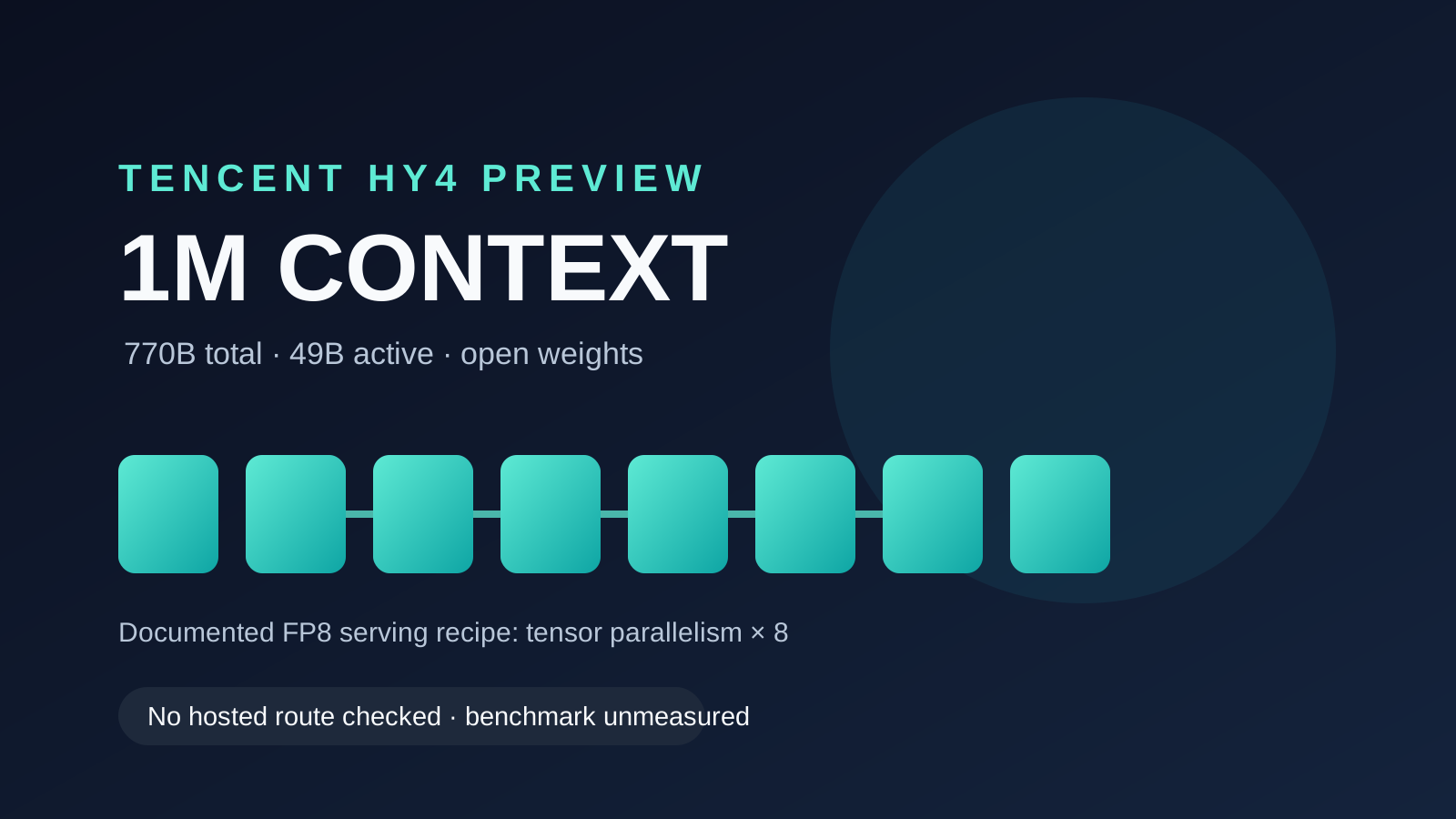
Watch Hy4 preview, but do not route private work or declare it a coding winner yet. The public card supports a serious self-hosting recipe; this project has neither an approved hosted route nor the eight-GPU hardware to run the fixed benchmark.
Tencent released Hy4 preview on August 28, 2026 as a preview open-weight model aimed at software engineering, research, and financial-analysis work.[3] Tencent’s card describes a Mixture-of-Experts model with 770B total parameters, 49B activated parameters per token, and a 1M-token context window; those are vendor specifications, not independent performance measurements.[1]
What is actually published
The exact base identifier is tencent/Hy4-preview; the FP8 quantized instruct release is tencent/Hy4-preview-FP8; and Tencent’s documented local OpenAI-compatible server uses the served name hy4-preview.[1][2] Both retrieved model cards state Apache License 2.0.[1][2]
Hugging Face classifies the cards for text generation. The retrieved card does not specify image, audio, or video input/output modalities, so this is a text-model listing rather than evidence of a multimodal API.[1] Tencent’s productivity descriptions mention software engineering, office and analysis, game development, and scientific research; treat those as vendor positioning, not as a Superbash test result.[1]
Tencent’s own known-limitations section matters more than its launch chart for an early deployment decision: it says Hy4 preview can spend longer than necessary reasoning through complex tasks and can over-verify its work.[1] Reuters independently reported the same release date, model scale, intended work categories, and the company’s warning about lengthy reasoning and over-verification.[3]
Access and hardware: the current constraint
At the August 31 check, Hugging Face showed no hosted Inference Provider for either tencent/Hy4-preview or tencent/Hy4-preview-FP8.[1][2] The official quickstart instead documents self-hosting through vLLM or SGLang. Its vLLM recipe runs tencent/Hy4-preview-FP8 with --tensor-parallel-size 8, and the SGLang recipe similarly uses --tp-size 8; that is the verified serving recipe, not a claim that every eight-GPU configuration is sufficient.[1][2]
This benchmark worker has no nvidia-smi binary and no approved paid infrastructure. Therefore it did not download weights, send repository data to an unverified third-party endpoint, or manufacture a benchmark score. The Hy4 benchmark packet records the fixed tasks, acceptance rule, host check, and explicit blocked result.
What Tencent’s launch scores do—and do not—show
Tencent presents benchmark tables and an internal expert comparison in the model card. Those figures are company claims under Tencent’s setup; they are useful leads, not a substitute for the same tool permissions, budgets, acceptance tests, and human correction accounting used for a Superbash workflow.[1]
Our editorial recommendation is consequently neutral: do not promote Hy4 preview as a coding default until it completes at least two of three fixed public coding/agent tasks under an approved route and the same harness as the comparison baseline. A run is accepted only if its task-specific tests pass, git diff --check passes, no unrelated files change, and every requested artifact exists. The public packet reports an unmeasured 0/0 result rather than converting access uncertainty into a failure or a win.
If you have approved infrastructure
- Use an isolated public or sanitized repository; do not upload private source, credentials, or customer data to a newly discovered route.
- Start with Tencent’s documented FP8 recipe and record the exact image, model revision, GPU count/type, tensor parallelism, context setting, and cost assumption.[1]
- Run the three fixed tasks sequentially against
hy4-previewand the named baseline with identical tools, permissions, token/time budgets, and acceptance tests. - Record raw outputs, elapsed time, retries, token counts, provider or self-host cost assumptions, and human correction time. Do not infer those numbers from the vendor card.
- Make a positive recommendation only when at least two of the three Hy4 results are accepted; otherwise publish the failures and caveats.
The release is important because the weights and serving guidance are public under Apache-2.0. It is not yet evidence that Hy4 is an economical or reliable default for a real agent workflow. The operational question is still open: can a lawful, approved route complete your reviewed task better than its baseline?
Sources
[1] https://huggingface.co/tencent/Hy4-preview — Tencent Hy4 preview model card [2] https://huggingface.co/tencent/Hy4-preview-FP8 — Tencent Hy4 preview-FP8 model card [3] https://www.reuters.com/world/asia-pacific/chinas-tencent-releases-new-open-source-ai-model-coding-research-tasks-2026-08-28 — Reuters launch report
Put this to work
Separate open weights from easy access: an Apache-2.0 download does not make a 770B model a low-friction local test.
Try
Use the fixed public-task packet in `benchmarks/hy4-preview/` only after an approved route and equivalent baseline are available.
Prove it worked
Count a run only when its task test, clean diff, requested artifacts, and scope checks all pass.
Where it can pay
For client work, price the verified route, review time, and accepted-result rate—not a vendor leaderboard score.
Keep in view
- Tencent's model card lists Hy4 preview as a 770B-total, 49B-active MoE with a 1M-token context window.
- Tencent releases both `tencent/Hy4-preview` and `tencent/Hy4-preview-FP8` under Apache-2.0; the documented FP8 serving recipe uses tensor parallelism across eight GPUs.
- At check time, Hugging Face listed text generation but no hosted Inference Provider for either model card.