Grok Bot · Tutorial 09
Connect Grok Bot to Apps with Plugins
Add one connector through Grok Bot's Plugins settings, grant the minimum access, and prove the connection with a read-only task.

0 of 1 complete
Reference guide · Read when needed · View the route
Last tested and updated: August 12, 2026
A connector gives Grok Bot a structured way to work with an app. In the current Grok Bot interface, connectors appear under Plugins. When a connector exists, it is usually more reliable than asking a Bot to click through a website.
Start with one read-only connection to a service you understand. Prove what the Bot can see before you allow it to create, update, send, or delete anything.
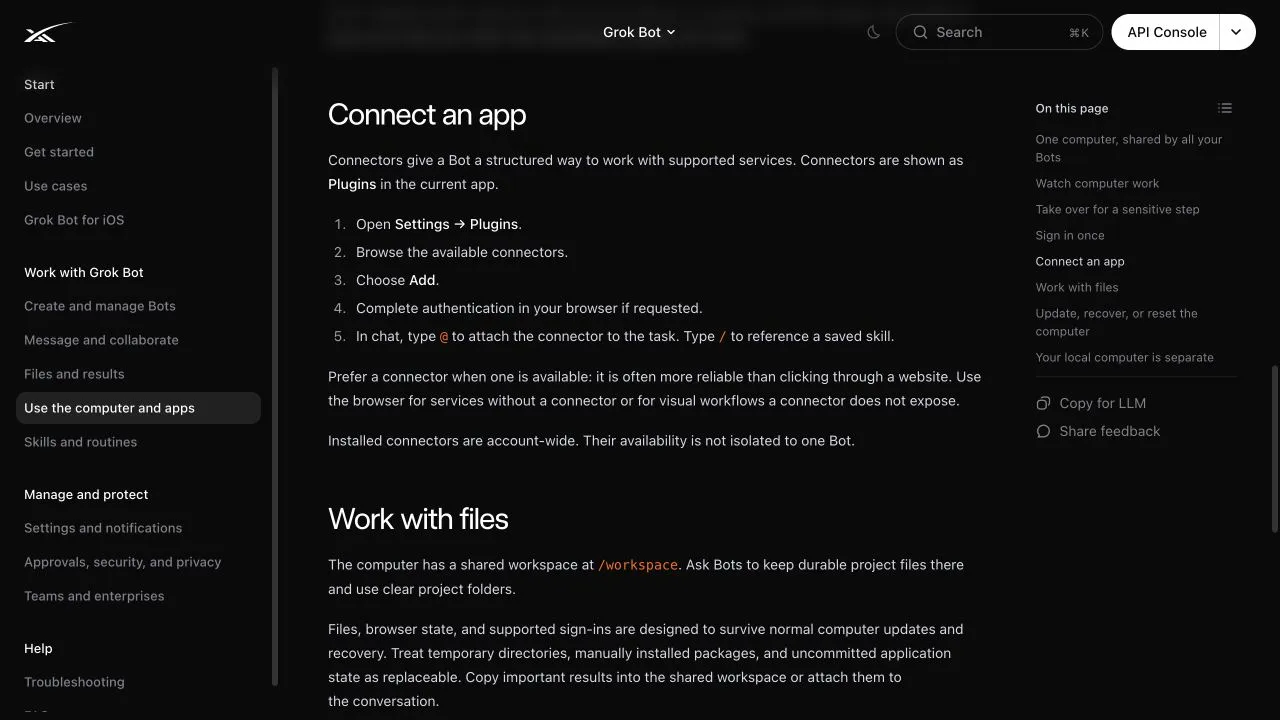
Official documentation captured from SpaceXAI’s Use the computer and apps guide on August 12, 2026. This is a public documentation page, not an authenticated plugin marketplace.
What a plugin can contain
In Grok Bot, Plugins is the place to discover connectors and packaged skills. A connector links a service to the Bot through a structured integration, often an MCP server. A skill tells the Bot how to use tools for a repeatable job.
The two work well together:
- The connector supplies access to the app.
- The skill supplies the procedure and rules.
For example, a connector may let the Bot read issues from a project tracker. A skill can tell it which project to inspect, how to classify overdue items, and what report to return.
Account-wide access is the important boundary
Installed connectors are account-wide. Their availability is not isolated to one Bot. Private skills can be enabled per Bot, but the underlying connector or login belongs to the broader account environment.
All Bots also share one cloud computer. If you sign into a website in the shared browser, the session is available to the rest of your Bot roster.
Connector or browser?
Prefer the connector when it covers the job. Use browser computer control when the service has no connector or the workflow depends on a visual action the connector does not expose.
| Need | Better starting point | Why |
|---|---|---|
| Search records or retrieve files | Connector | Structured inputs and results are easier to verify |
| Update a supported object | Connector with approval | The proposed change can be scoped precisely |
| Work in a site with no connector | Browser | The Bot can use the visible interface |
| Complete a CAPTCHA or two-factor check | Human takeover | The Bot should hand the sensitive step to you |
| Perform a visual layout check | Browser | The page itself is part of the evidence |
A connector is not automatically safe. It may expose powerful write or delete operations. Review what the source service authorizes and keep consequential actions behind approval.
Connect your first app
- Open Settings.
- Choose Plugins.
- Browse the available connectors.
- Choose Add on the service you need.
- Complete authentication in your browser if requested.
- Read the permissions shown by the source service.
- Return to chat and type
@to attach the connector to a task. - Run a read-only test.
Type / to reference a saved skill. Type @ for Bots, groups, routines, and connectors.
Do not paste a password, one-time code, API key, or recovery phrase into ordinary chat. If a Bot reaches a password, passkey, two-factor prompt, CAPTCHA, payment, or identity check, take control of the computer and complete only that step yourself. For a supported secure secret request, enter the value in the masked handoff interface.
Use the least access you can
Before connecting, answer four questions:
- What exact data does this workflow need to read?
- Does the workflow need to write anything?
- Can I use a test workspace or service account?
- How will I revoke access when the project ends?
For a first task, choose read access and a narrow scope. If the source service offers project, folder, repository, or team restrictions, use them.
Avoid “connect everything now” onboarding. Each connector expands what a mistaken instruction, compromised webpage, or confused Bot could reach.
Practical exercise: read-only project digest
Choose a low-risk source such as a test project, test repository, or non-confidential document folder.
Define the request
Using @MyConnector, list the five most recently updated items in the test project. Return each item’s title, last-updated time, status, and direct link. Do not create, edit, comment, send, archive, or delete anything. If the connector cannot confirm a field, label it unavailable.
Verify the result
- Open each returned link.
- Check that the five items are actually the most recent.
- Confirm that no record changed.
- Check the connected service’s activity or security log if it provides one.
- Ask the Bot to list which connector operations it used.
Disconnect and test revocation
Remove the connector in Grok Bot, then revoke the authorization in the source service. Ask the Bot to run the same request again. It should report that access is unavailable.
Success criteria
- Authentication completes through the official service flow.
- The Bot reads only the intended test scope.
- Every returned item has a direct link.
- No write action occurs.
- Revocation prevents another successful read.
Add a skill after the connector works
Once the read-only request succeeds, save the procedure as a skill:
Save this as a skill called “Test project digest.” Require the named connector, use only the test project, return five linked items in last-updated order, label missing fields, and prohibit all write actions.
Installed private skills can be enabled per Bot. If the skill is missing from the / menu, open Settings → Plugins → Yours and enable it for the current Bot.
Common failures
| Problem | Likely cause | Fix |
|---|---|---|
| The connector is missing | It is not installed, not enabled, or blocked by team policy | Check Plugins and ask the team admin about MCP policy |
| Authentication succeeds but the Bot sees nothing | The source account lacks access to the target scope | Verify permissions in the source service |
| The Bot clicks the website instead of using the connector | The connector was not attached or lacks the needed operation | Mention it with @ and ask which tool it plans to use |
| Another Bot can use the connection | Connectors are account-wide | Treat the whole roster as one boundary and narrow source permissions |
| A connection stops working later | The session or authorization expired | Reconnect through the official flow, then rerun the read-only test |
| A plugin is disabled for a team member | Team MCP policy blocks its server | An admin must review the allowlist or plugin policy |
Team and enterprise admins manage Grok Bot plugin and MCP policy through Cursor team settings. A blocked server appears disabled. Grok Bot does not have a separate plugin policy that bypasses those team controls.
What the source video adds
At 06:24, Alex Finn tours the plugin marketplace and describes connecting outside services. His video is useful for recognizing the interface, but the available catalog and permissions can change. Check the live Settings → Plugins screen before naming a connector as supported.
The video also uses “plugins” broadly. Current official documentation clarifies that connectors appear as Plugins in the Grok Bot app, installed connectors are account-wide, and saved skills are referenced separately with /.