Grok Bot · Tutorial 04
The Grok Bot Brain-Dump Method
Give a Bot useful context, ask it what to delegate, and turn its suggestions into a safe first automation backlog.
0 of 8 complete
Essentials · Step 6 of 8 · View the route
Last tested and updated: August 2026
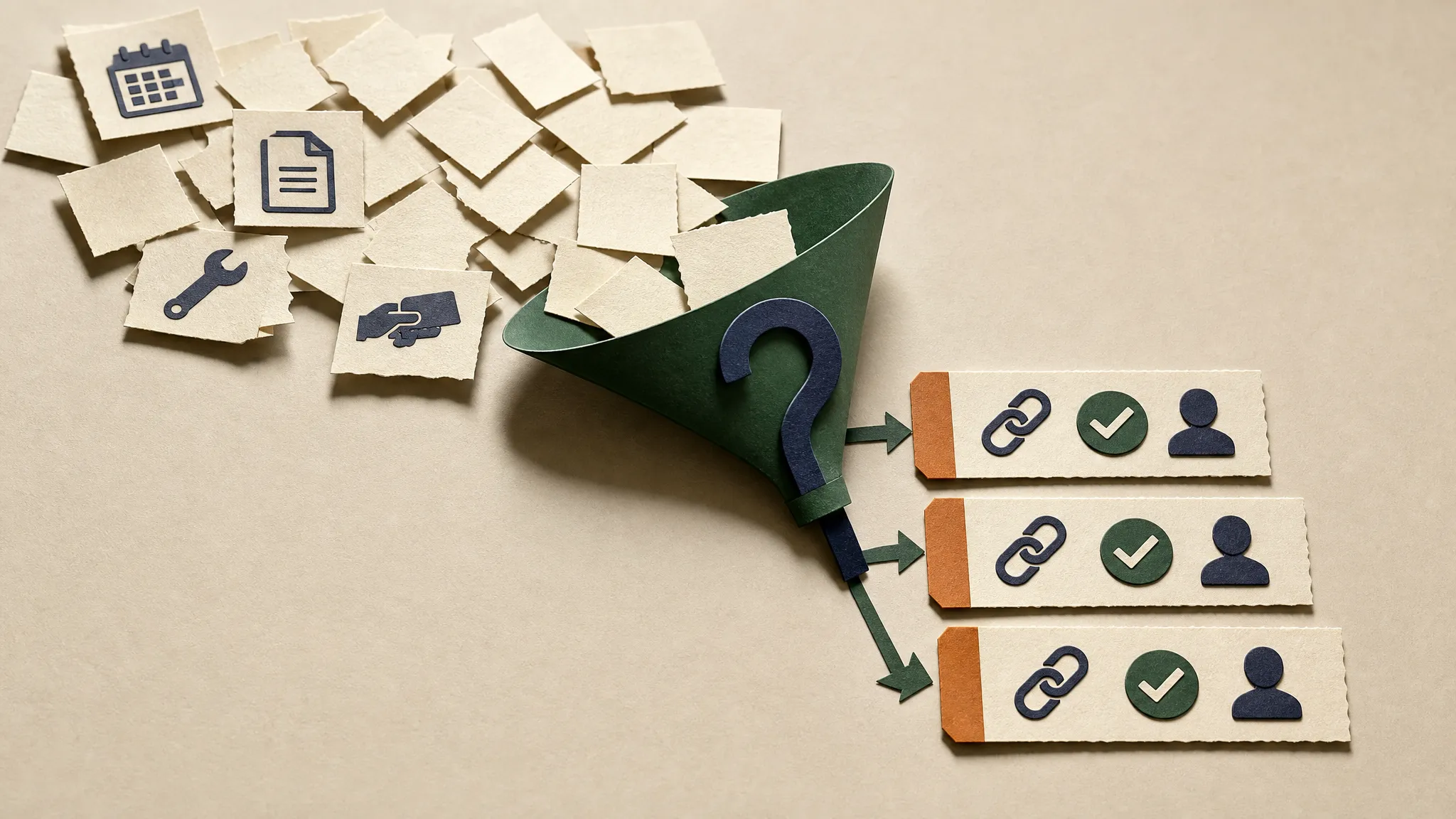
New agent users often face an awkward blank box: “What should I ask it to do?” A brain dump solves that by giving the Bot a map of your work. A reverse prompt then asks the Bot to suggest jobs that fit that map.
Alex Finn demonstrates this onboarding idea at 08:07: explain your role, responsibilities, tools, and recurring work, then ask what the agent can do for you. This is his suggested method, not a required Grok Bot feature or an official setup step.
Do a useful brain dump, not a data dump
The goal is enough context to spot repeatable work. It is not an excuse to paste every private document you own.
Include:
- Your role and the outcomes you own
- Work you repeat every day, week, or month
- Tools and source systems involved
- What a good deliverable looks like
- Decisions that require your judgment
- Actions the Bot must never take without approval
- Recurring annoyances, handoffs, and unfinished queues
Leave out:
- Passwords, API keys, recovery codes, or session tokens
- Customer data that is unnecessary for task discovery
- Private health, legal, financial, or identity information
- Whole inboxes or drives when a short description is enough
- Access to production systems during ideation
Copy this brain-dump template
My role:
I run content and research for a small AI education site.

What I produce:
Beginner tutorials, research briefs, and a weekly newsletter.

Recurring work:
- Review new product announcements each morning.
- Turn one video transcript into a source-checked article outline.
- Check drafts for unsupported claims before publication.
- Prepare a Friday summary of work completed and open questions.

Tools and sources:
Public product documentation, YouTube transcripts, our content folder, and an analytics dashboard.

Quality standard:
Every factual claim needs a direct source. Creator commentary must be labeled as commentary. The final draft should be useful to a first-time user.

Approval boundaries:
Do not publish, send messages, connect accounts, delete files, or change the website. Drafts only until I approve.

Sensitive information:
Do not ask for passwords, customer records, private analytics exports, or access tokens.
Keep the first version short enough to review carefully. You can add detail after the Bot shows that it needs it.
Ask the reverse prompt
Paste this after the brain dump:
Based only on the work described above, suggest ten tasks I could delegate.

For each suggestion, include:
1. The finished deliverable
2. The sources or tools required
3. How often it happens
4. The main risk
5. Where human approval is required
6. A small read-only test I can run first

Rank the suggestions by time saved and ease of verification.
Do not connect a tool or create a routine yet.
The last sentence matters. You are asking for an automation backlog, not authorizing changes.
Reject vague suggestions
“Help with marketing” is not a task. “Every Monday, compare this week’s five published articles with the editorial calendar and draft a missing-items report” is.
Use this filter:
| Question | Good sign |
|---|---|
| Is the trigger clear? | A date, new file, or explicit request starts the work. |
| Is the output visible? | You receive a file, table, draft, or linked report. |
| Can you check it? | The output preserves source links and inputs. |
| Is failure reversible? | A bad run creates a poor draft rather than sending or deleting. |
| Is the access narrow? | The Bot needs only the named sources. |
Discard suggestions that cannot pass at least four of these tests.
Turn one suggestion into a pilot
Choose a frequent, low-risk task. Rewrite it as a one-time job:
Using only the five URLs in this message, create a morning research brief.
For each item, include the publication date, the direct source, and one sentence on why it may matter to our learners.
Put uncertain claims in a separate "Needs verification" section.
Do not open other accounts, send messages, or create a routine.
Run it three times with different inputs. Note how often you intervene, how many factual corrections it needs, and how long review takes. Only then consider turning it into a skill or routine.
Update or remove context
Correct a durable assumption plainly:
Update your working context: our newsletter now publishes on Thursday, not Friday. Confirm the change and identify any saved routines that still use Friday. Do not edit those routines until I approve.For sensitive or obsolete material, remove it from the relevant source, conversation, shared workspace, connector, or saved routine. Deleting one Bot does not automatically remove shared-computer files or browser sessions.
Exercise: build your delegation backlog
- Complete the template without secrets or customer data.
- Run the reverse prompt.
- Score each suggestion from 1 to 5 for value, verifiability, reversibility, and access risk.
- Pick the suggestion with strong value and the lowest risk.
- Turn it into a one-time, read-only pilot.
- Record the result, corrections, and review time.
Your exercise is complete when you have one tested task, not when you have ten attractive ideas.
Sources and evidence boundary
- Official Grok Bot overview, for task structure, durable context, and shared-computer behavior
- Official Create and manage Bots guide, for memory and role guidance
- Official approvals, security, and privacy guide, for approval and access boundaries
- Alex Finn video at 08:07, source of the brain-dump and reverse-prompt suggestion
The brain-dump method is a practical onboarding technique. The official product sources do not promise that suggested tasks will be useful or safe. You still have to review, narrow, and test them.
What’s next
Learn where the work actually runs in L05: How Grok Bot’s Cloud Computer Works.