AI Models · Tutorial 02
Claude Haiku vs Sonnet vs Opus
Compare Claude Haiku, Sonnet, and Opus in 2026, then match each tier to the work instead of wasting hundreds of dollars a month.

0 of 1 complete
Reference guide · Read when needed · View the route
Last tested and updated: June 2026
Anthropic ships three Claude tiers in 2026: Haiku, Sonnet, Opus. Picking the wrong one costs hours and dollars.
This lesson gives you a plain-English way to choose a tier on the first try.
Start at L01: What Is an AI Model Tier List? if you haven’t yet.
One family, three costs
Picture three people at a desk:
- Haiku: intern. Fast, cheap, volume work.
- Sonnet: senior IC. Five times the cost, eighty percent of your work.
- Opus: partner. Slow, expensive, when being wrong costs a customer. Use it on tasks that don’t decompose cleanly.
That metaphor maps to Anthropic’s actual 2026 lineup. The three Claude models share one family and one API. They dial the trade-off between speed, cost, and capability.
Speed, capability, and price
The speed-vs-capability matrix is the only diagram you need. Cost climbs as you move up-and-left.
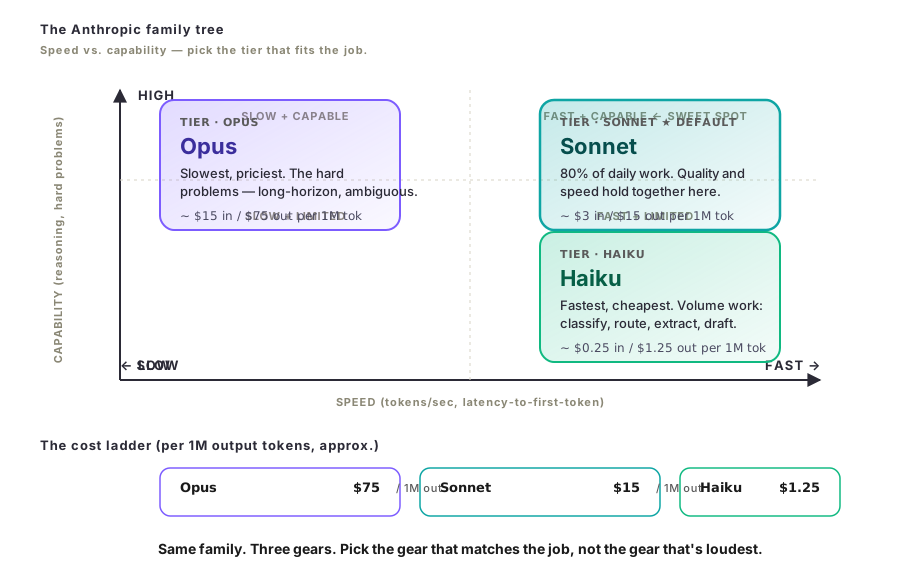
Three rules to internalize from the diagram:
- Up-and-left = smarter and pricier. Capability is the y-axis; pricing scales with it.
- Right = faster replies. Haiku can finish a classification call before Opus starts its first sentence.
- Sonnet is the sweet spot for almost everyone. It lives in the fast-and-capable quadrant. The intern and the partner are corners; the senior IC is the centre of mass.
Y-axis: how often does it have to think twice? X-axis: how many answers can you wait for? Built-in-answer tasks (classify, extract, summarise) live low. Construct-an-answer tasks live high.
Cross-tier moves swing your bill 5 to 60×. Version bumps inside a tier swing it ~1.2×. Optimise tier first, version second. Check Anthropic’s pricing page before trusting any number you read, including this one.
Choose Haiku, Sonnet, or Opus
Default Sonnet, escalate Opus, downgrade Haiku. Save this table for every new Claude project.
| If your task looks like… | Reach for | Why |
|---|---|---|
| Classify, route, extract, summarise in bulk | Haiku | 12× cheaper than Sonnet per token; quality is fine for structured volume work |
| Daily Q&A, drafting emails, code review, refactoring, and coding sessions with a test suite | Sonnet | Best price-for-capability. This should be your default for roughly 80% of work. Verify-by-running loops don’t need Opus-level reasoning: see hermes/L01: coding harness vs agent harness. |
| Hard reasoning, ambiguous problem statement, multi-day planning | Opus | Pays for itself when re-doing the task on Sonnet would cost more in your time |
| Long-document analysis where nuance matters, or one-shots where “good enough” fails | Opus | Better calibration means less hallucinated detail; will rewrite until tone lands |
| Anything running in a tight cron loop, hundreds of times a day | Haiku | Latency and cost compound; Sonnet burns a real bill at scale |
The decision doesn’t have to be a commitment. Most Claude clients let you flip tiers per-conversation. The right habit: start at Sonnet, escalate to Opus at a wall, downgrade to Haiku when the wall was you.
Where this gets you in real money
Run ten million output tokens this month, a normal personal project, and the bill changes sharply by tier:
- Haiku: roughly $12
- Sonnet: roughly $150
- Opus: roughly $750
The same ten million tokens. A 60× spread between cheapest and most expensive. Picking correctly is the difference between a coffee a month and a car payment.
Open-weight side (Kimi, DeepSeek, GLM, Qwen): L03 and L04. Full decision framework across all providers: L05.
Compare one task across the family
Run the same task on all three tiers. Then decide which tier you trust.
The exercise
Pick one task you actually did this week. Run the same task on Haiku, Sonnet, and Opus, then compare the results.
For each tier, ask yourself three questions:
- Did I get a usable answer on the first try, or did I have to push back?
- How long did it take to first token?
- What did this cost me, in API dollars or in subscription budget?
You don’t need precise numbers: a spreadsheet is enough. Feel the trade-off in your own hands.
Success criteria: Name the task, the wall-clock difference, the quality difference, and your default tier.
Suggested first-week workload split
A $20/month beginner budget looks roughly like this:
- ~70% of tokens on Sonnet. Daily Q&A, drafting, code review, summarisation. This is your workhorse.
- ~25% on Haiku. Volume work like routing, classification, the cron-loop stuff you automate later.
- ~5% on Opus. Reserved for the one or two tasks per week where you actually need the partner-on-call.
The percentages will swing as you find more or fewer walls. Start there, adjust at the end of each week.
Common failure modes to expect
Three problems tend to show up in the first month.
If Opus solves one hard problem, it is tempting to leave it on “to be safe.” Two weeks later, the bill is five times what you planned. Set Sonnet as the project default and opt into Opus only when the task earns it.
Haiku has the opposite problem. A request such as “extract the dates from these 200 emails” may contain more judgement than it first appears. Getting 80% right and 20% confidently wrong can make the cheap run expensive.
Sonnet sometimes returns a usable answer that is not quite what you would have written. Sending every one of those drafts to Opus means paying twice. Decide in advance which work deserves a second opinion. A private draft can stay with Sonnet; a customer-facing draft may be worth the audit.
What’s next
- L03: Chinese open-weight models
- L04: Cost-efficient tier
- L05: Frontier vs Open-Weight: Decision Framework
- Hermes L01: What Is Hermes Agent?