Brief 17 · Prompt edition 2.0
Prism Freight Pavilion
Build a polished interactive freight-exhibition pavilion in one self-contained HTML file: six labeled exhibits occupy six floor bays, and an exact solver finds the best legal arrangement or explains the smallest set of removable rules that prevents one.
Read the complete prompt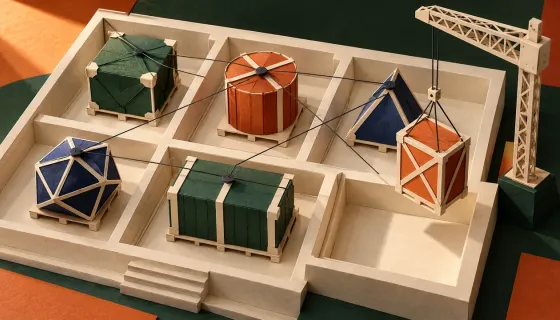
1 recorded evaluation of this frozen brief · artifacts published unedited
Recorded evaluations
Each artifact was produced against edition 2.0 of this brief and is published exactly as delivered. The model run page links the run record, which states which source-level checks were performed, which checks remain for a human browser review, and how this delivery differs from a hosted-API single-message episode.
What this tests
multi-constraint reasoning in a tight artifact; exact static assignment, optimality, infeasibility, and minimal relaxation.
Proposed difficulty
harder than Watch/Stormwind on combinatorial correctness and infeasibility explanations; intentionally less demanding in 3D rendering. The small search domain prevents “harder” from meaning unbounded compute.
These are design hypotheses, not observations of model failure. Empirical discrimination has not been measured.
One message, one HTML response
One complete prompt as one user message; one self-contained HTML response. No tools, external dependencies or follow-up repair turns during authoring. Private reasoning is unrestricted. A human reviewer later checks the artifact in a browser; model self-reported success is not evidence.
Do not append BENCHMARK-PROMPT.md to this brief.
Rubric and pass rules
Each rubric has five binary criteria worth 20 design points each. Award a criterion only when every named check succeeds; otherwise award zero. These are rubric weights, not model scores. Passing requires all five criteria, every embedded checklist item and the shared delivery gate: exactly one self-contained HTML artifact, no external requests or dependencies, no tools during generation and no placeholder mechanisms. Review at 1280×800 and 390×844 with keyboard navigation and reduced motion. Use ledgers, exports, independent arithmetic and source inspection.
- Exact assignment · 20 design points
- Checklist 2 and 6; exhaustive 720 candidates, legality count, cost and both tie-breaks agree with independent enumeration.
- Infeasibility reasoning · 20 design points
- Checklist 4–5; [c1] is minimal for A pinned to 4; capacity and duplicate-pin contradictions cannot be “fixed” by removing soft rules.
- State coherence · 20 design points
- Checklist 3 and 7; edits invalidate results, manual violations stay visible, Apply and Reset have the specified scope.
- Evidence fidelity · 20 design points
- Exports, cost contributions and board agree after defaults and reviewer edits; source uses the actual configuration and a complete search.
- Artifact and usability · 20 design points
- Shared delivery gate plus checklist 1 and 7; illustrated board, instructions, keyboard, mobile, reduced motion and themes.
Pass: every criterion and checklist item.
Review beyond the examples
reviewers vary weights, preferred bays, pins and enabled rules within the declared domain, including ties and infeasible cases; use independent permutation arithmetic rather than the app's counter. Fixed acceptance examples are sanity checks, not the whole domain. This is an original exhibit system rather than a named puzzle recreation. Cosmetic renaming is not claimed to prevent memorization; editable inputs and proof obligations do the work.
Versions and prompt revisions
Superbench 1.x results retain their original protocols. The core/specialist repository-run workflow does not schedule v2. City Scroll’s media-assisted specialist protocol remains separate. Results across versions are not quantitatively comparable, and no historical scores are migrated.
Edition 2.0 is the launch contract. Changes to behavior, fixtures or pass criteria require a new documented edition; future evaluations must retain the exact evaluated prompt revision. Typographic corrections must be identified.