Product case study · August 25, 2026
Xiaomi AI Cube vs DGX Spark: prototype versus product
Compare Xiaomi's three-chip AI Cube prototype with NVIDIA DGX Spark, including memory, model claims, software, price, and the missing benchmark.

Xiaomi's AI Cube has a promising near-memory accelerator, but it is still a prototype with no price, release date, complete memory map, public software stack, or matched benchmark. DGX Spark is slower on one bandwidth headline but is documented, supported, and available now.
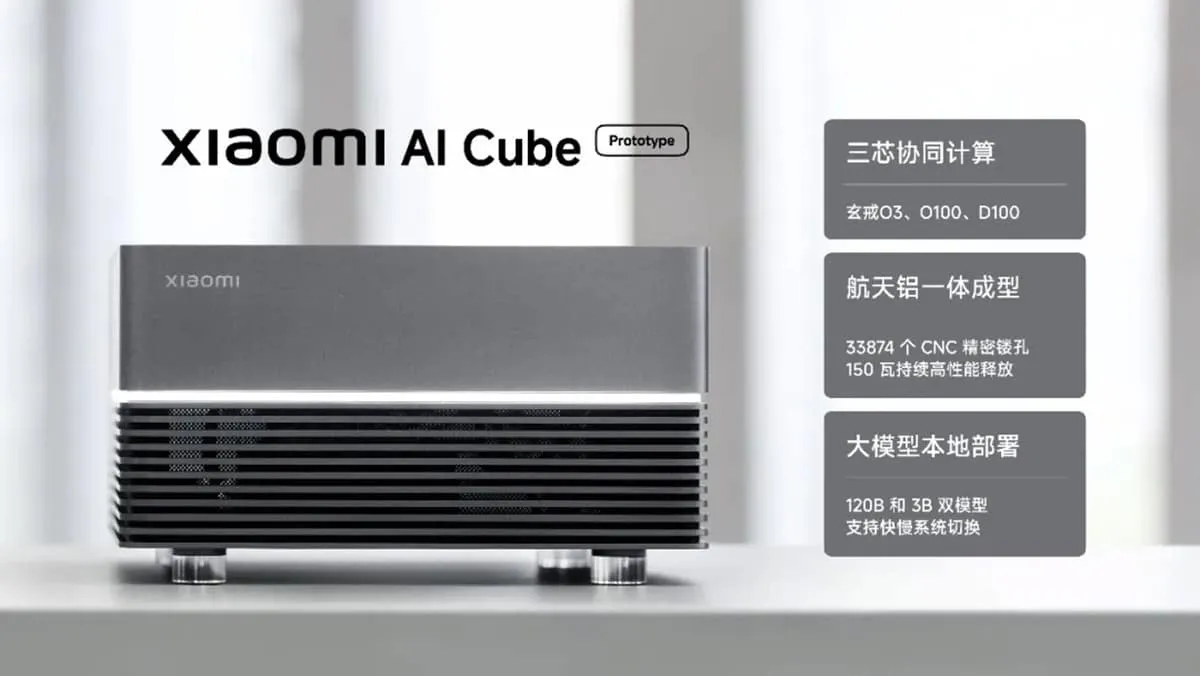
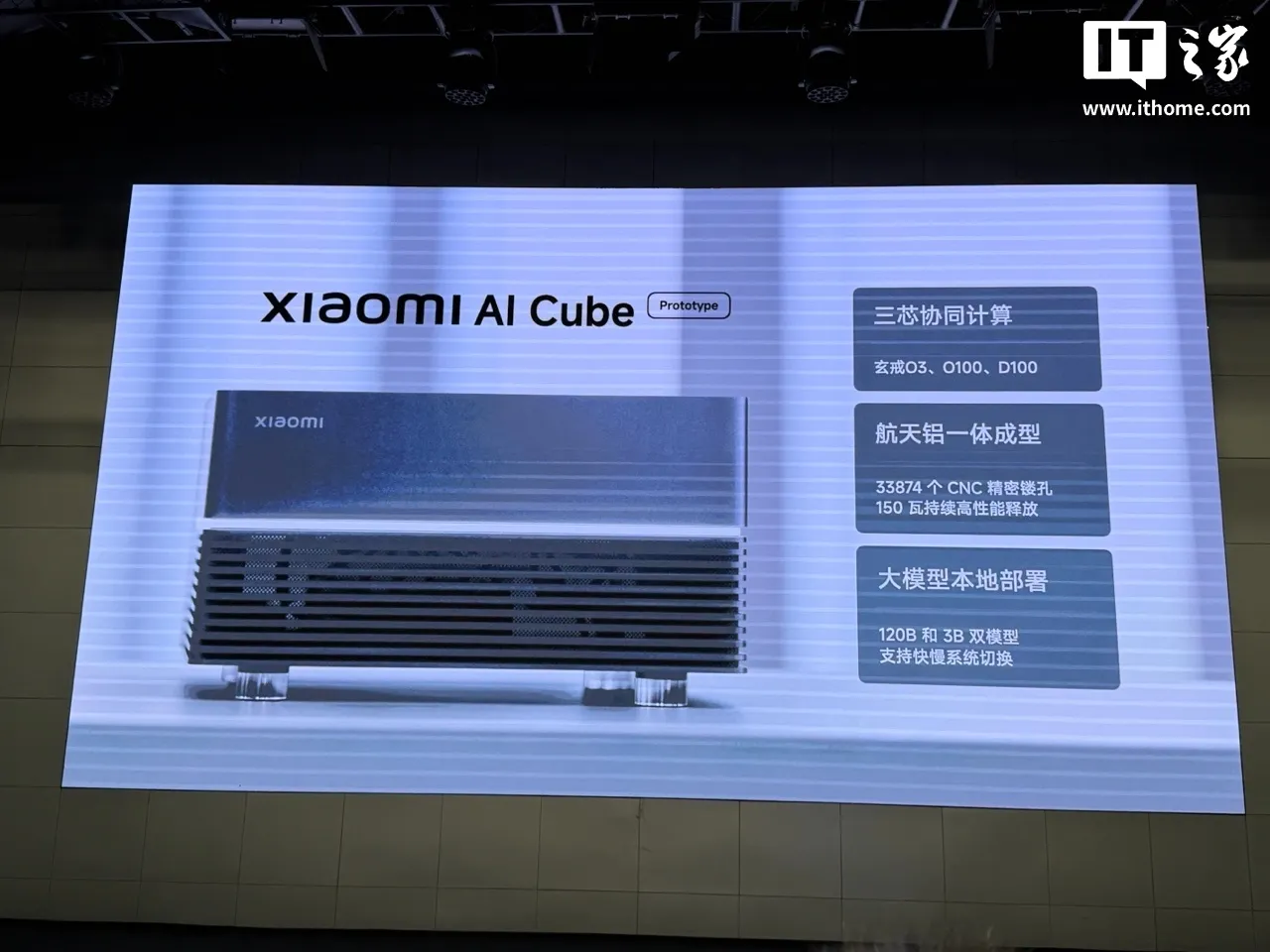
Xiaomi demonstrated a compact local-AI computer with three in-house processors, a claimed 1.22TB/s near-memory path, and local 120B plus 3B model deployment. It looks like a DGX Spark competitor, but the products are not at the same stage.
DGX Spark is available and documented. AI Cube is an engineering prototype. Xiaomi has not announced the Cube’s price, release date, installed memory, storage, ports, operating system, public runtime, or matched benchmark.
Direct comparison
| Specification | Xiaomi AI Cube prototype | NVIDIA DGX Spark |
|---|---|---|
| Status, August 2026 | Demonstrated; no retail commitment | Shipping product |
| Architecture | XRING O3 + O100 + D100 | GB10 Grace Blackwell Superchip |
| Memory capacity | Not disclosed; D100 supports up to 160GB | 128GB coherent LPDDR5X |
| Published bandwidth | O100: 1.22TB/s near-memory; O3: up to 113.8GB/s | 273GB/s coherent system memory |
| Local-model claim | 120B + 3B dual-model deployment | Models up to 200B, subject to format and runtime |
| Published token result | Up to 330 tokens/s on MiMo 3B in Xiaomi’s lab | No universal rate; depends on model and runtime |
| Compute or thermal figure | 150W sustained performance release | GB10 TDP 140W; 240W adapter |
| Storage and networking | Not disclosed | 4TB NVMe, 10GbE, Wi-Fi 7, dual ConnectX-7 |
| Software | Not disclosed | DGX OS, CUDA, PyTorch, TensorRT-LLM, vLLM, llama.cpp, and others |
| Price | Not announced | $4,699 current NVIDIA MSRP |
Component maximums are not system benchmarks. Xiaomi’s 1.22TB/s figure and NVIDIA’s 273GB/s figure describe different memory scopes.
Why Xiaomi uses three chips
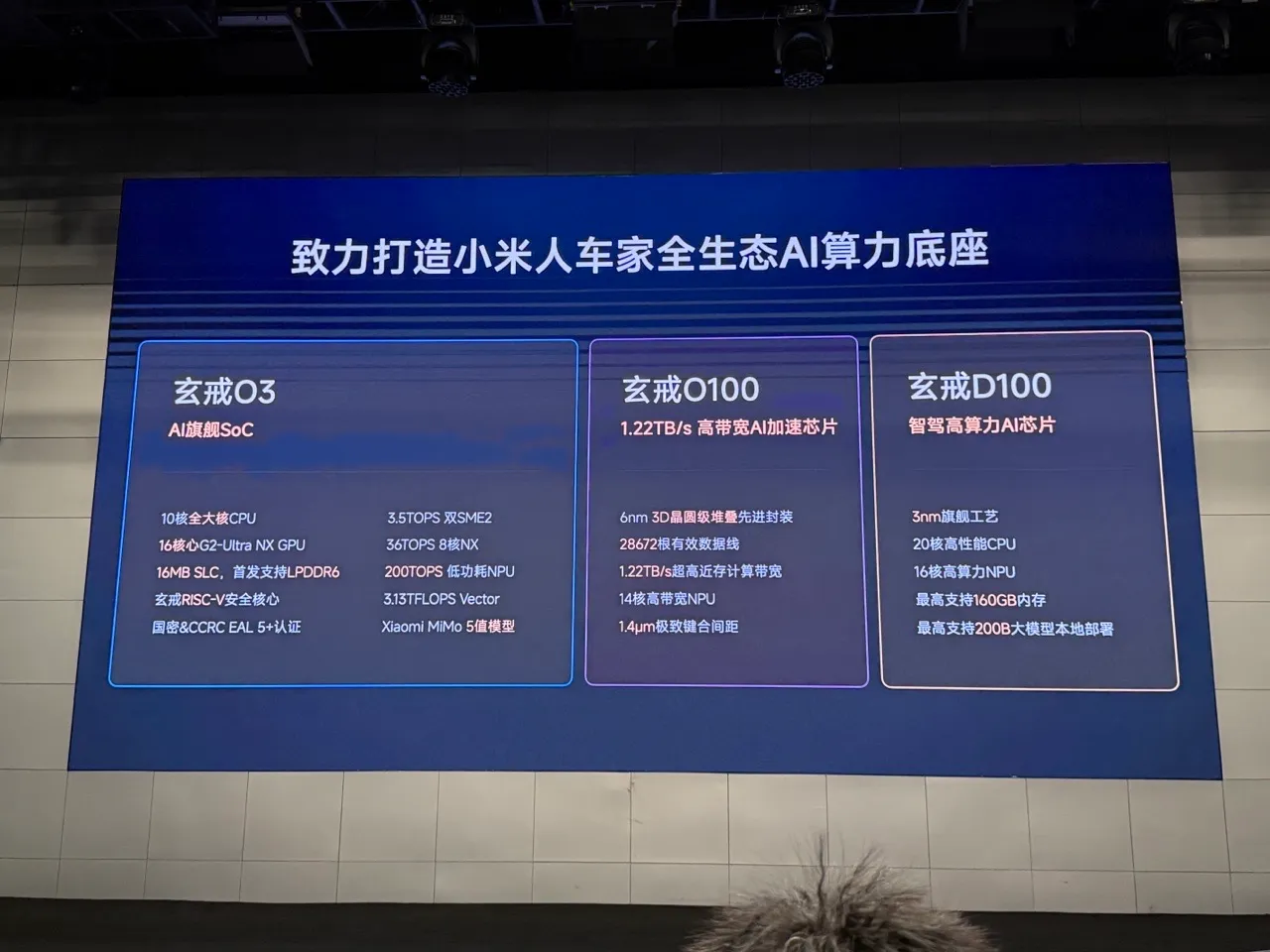
- XRING O3 supplies general compute, graphics, and a low-power NPU.
- XRING O100 is the specialist inference accelerator with stacked DRAM and a claimed 1.22TB/s local interface.
- XRING D100 is an intelligent-driving processor with a 20-core CPU, 16-core NPU, and support for up to 160GB unified memory.
The missing detail is how those chips share work and memory. Xiaomi has not published the inter-chip fabric, coherency model, copy cost, or the chip used for each stage of the 120B workload. Three accelerators help only if data movement does not erase their individual advantages.
What O100 may solve
Large-model token generation often becomes limited by memory movement. O100 places two high-speed DRAM wafers above a 6nm logic layer with 14 NPU cores. Xiaomi reports 28,672 effective data connections and up to 1.22TB/s of local bandwidth.
That design could improve decode speed when the working model fits in the stacked memory. Xiaomi has not disclosed how much DRAM O100 contains. A small fast tier can make a 3B model quick while a 120B model still depends on a slower capacity tier.
What 330 tokens/s does not prove
Xiaomi’s 330 tokens/s result used its MiMo 3B model. The company did not publish the input length, output length, batch size, exact format, runtime version, time to first token, or wall power. It was not the 120B model.
| Dense model example | Approximate raw weights at 4-bit | Ideal full-weight scans per second at 1.22TB/s* |
|---|---|---|
| 3B | 1.5GB | 813 |
| 30B | 15GB | 81 |
| 70B | 35GB | 35 |
| 120B | 60GB | 20 |
*This is a bandwidth illustration, not a speed forecast. It excludes caches, mixture-of-experts routing, compression, compute limits, context traffic, and runtime overhead.
The table shows why a 3B result says little about a 120B workload. A defensible comparison requires the same public model, quantization, context, batch size, output length, and quality settings on both machines.
Why the 120B plus 3B design is useful
A small local model can classify a request, retrieve a file, or decide whether the task is simple. A larger model can handle deeper reasoning and difficult generation. Routing can reduce latency and avoid using the large model for every step.
Xiaomi has not shown whether both models stay resident, how memory is divided, whether context survives a handoff, or whether third-party models can use the same route. The concept is useful; the developer platform is not yet public.
Where DGX Spark is ahead
DGX Spark provides one coherent 128GB memory pool and a documented software path. Developers can use CUDA, PyTorch, NVIDIA containers, TensorRT-LLM, vLLM, llama.cpp, Ollama, and LM Studio. NVIDIA also publishes deployment and fine-tuning guides.
Its limitations are known. The 273GB/s memory interface can constrain single-user decode on large dense models. The Arm64 host can complicate x86-only software. The $4,699 price is high, and the 1 PFLOP headline assumes sparse FP4 work.
Those limits can be measured because the product exists.
Buying decision
Buy DGX Spark if you need 128GB of local model capacity now, rely on CUDA or NVIDIA containers, or need a documented deployment path.
Watch AI Cube if near-memory inference, local model routing, or Xiaomi’s edge ecosystem matters to you. There is nothing to buy yet.
Keep a conventional GPU workstation if your models fit in GPU memory and image, video, training, or x86 compatibility matter more than compact unified memory.
The benchmark Xiaomi needs to publish
- Exact model checkpoint and quantization.
- Installed D100 and O100 memory, plus inter-chip bandwidth.
- Context length, batch size, output length, and concurrency.
- Separate prefill rate, time to first token, decode rate, and aggregate throughput.
- Runtime and compiler versions with a reproducible command or container.
- Wall power and sustained performance after 30 minutes.
- The same test on DGX Spark with a public optimized runtime.
Until those results exist, AI Cube is an interesting architecture, not a proven DGX Spark replacement.
Sources
- IT Home: AI Cube specifications and three-chip configuration
- The Paper: XRING announcement and commercial timeline
- 36Kr: O100 architecture and stacked-memory details
- CnEVPost: D100 and the AI Cube demonstration
- NVIDIA: DGX Spark specifications
- NVIDIA: DGX Spark system overview
- NVIDIA: DGX Spark playbooks
- Tom’s Hardware: independent DGX Spark review
Put this to work
Separate memory capacity, memory bandwidth, precision, model size, prefill, and decode when reading local-AI claims.
Try
Write a matched benchmark using the same model, quantization, context, batch size, runtime, and wall-power measurement.
Prove it worked
Publish time to first token, decode rate, throughput, memory use, power, and task quality from both machines.
Where it can pay
A local-inference setup is valuable when it completes a private workflow reliably, not when it wins a component-spec comparison.
Keep in view
- Xiaomi's 150W AI Cube prototype combines XRING O3, O100, and D100. It is not a retail product.
- The claimed 1.22TB/s figure belongs to O100's near-memory interface; Xiaomi has not disclosed its fast-memory capacity.
- The 330 tokens/s demo used MiMo 3B, not the unnamed 120B model also shown on the Cube.
- DGX Spark provides 128GB coherent memory, a documented CUDA stack, and a current $4,699 MSRP.