Release guide · October 25, 2026
Kimi K3.1 Pro: 1M context, coding agents, and API pricing (Oct 2026)
Kimi K3.1 Pro brings 1M context and always-on thinking. Check API pricing, vendor coding scores, and scheduled open weights before routing agents.

Kimi K3.1 Pro is an October 24 Moonshot launch with public API IDs, 1M context, and published token rates. Coding, 3D, and finance results remain vendor-cited. Weights are scheduled by November 4; Superbash has no measured result for this release.
Sources checked October 25, 2026. This is a documentation-backed release analysis. Superbash has no measured run for Kimi K3.1 Pro: the specifications below come from Moonshot’s documentation, benchmark scores are vendor-cited, and the evaluation workflow is editorial advice.
The decision is whether to try the standard API or pay more for Highspeed on a bounded coding task. A million-token window is useful capacity, but it does not establish that an agent will finish your job correctly. The open-weight release is still scheduled, so an API evaluation and a self-hosting decision have different timelines.
What shipped on October 24, 2026
Moonshot launched Kimi K3.1 Pro and Kimi K3.1 Pro Highspeed on October 24. Its documented access routes include the web and mobile apps, Kimi Work version 3.1.0 or later, Kimi Code through its model selector, and the API. Enterprise access is off until an administrator enables it. API flagship access requires a successful top-up, with a $1 minimum; account tiers and rate limits depend on cumulative top-ups.[1][2]
Moonshot positions this as a “3T-class” post-training update built on K3, with joint reinforcement learning targeting coding, 3D work, finance, and agents. That is the vendor’s family description, not a separately confirmed exact parameter count for K3.1 Pro. The earlier K3 materials establish lineage only.[1][6][7]
Full weights are scheduled by November 4, 2026. As of this October 25 check, a scheduled release is not a downloaded model, a confirmed final license, or a validated local deployment.[1]
Exact IDs and serving constraints
The documented API IDs are kimi-k3.1-pro and kimi-k3.1-pro-highspeed. Both have a 1,048,576-token context window and always-on thinking. The top-level reasoning_effort accepts low, high, or max; the default is max. You cannot turn thinking off.[2][3]
| Setting | Documented behavior |
|---|---|
| Context window | 1,048,576 tokens |
| Thinking | Always enabled |
| Reasoning effort | low, high, max; default max |
max_completion_tokens | Default 131072; documented upper setting 1048576 |
| Sampling | Fixed values; omit sampling parameters from requests |
The completion setting and context window are different constraints. Their published upper values do not promise that a request can fill both independently at once. Define an output cap for the task instead of copying the largest available number.[2]
The quickstart documents image input through base64 or ms://, video through the files API, tool calling, structured JSON schema, streaming, and reasoning_content. It fixes temperature at 1.0, top_p at 0.95, n at 1, and presence/frequency penalties at zero. Preserve the complete assistant message when continuing a tool or multi-turn conversation. These are documented capabilities and integration requirements; we have not tested them here.[2][3]
Official tools use Formula. The quickstart specifically says its web search is being updated and is not recommended for production workflows in the near term. Do not treat a general tool-support checkbox as a production-readiness statement for that search tool.[2]
Pricing math builders actually need
Moonshot lists the following API rates in USD per million tokens, excluding applicable taxes. Context pricing is flat rather than tiered by prompt length.[4][5]
| API ID | Input, cache miss | Output | Cache hit | Cache write, 5m | Cache write, 1h |
|---|---|---|---|---|---|
kimi-k3.1-pro | $2.00 | $10.00 | $0.20 | $2.00 | $4.00 |
kimi-k3.1-pro-highspeed | $4.00 | $20.00 | $0.20 | $4.00 | $8.00 |
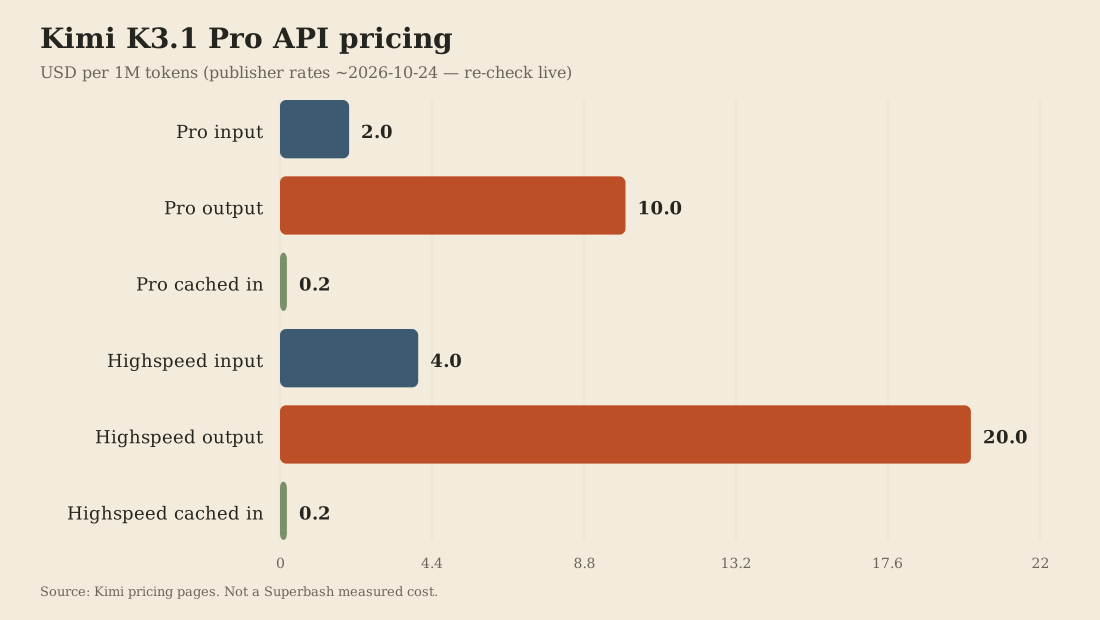
Highspeed doubles the listed input, output, and cache-write rates; cache hits remain $0.20. Moonshot claims 2–3× speed for the speed SKU. Superbash has not measured that speedup or established equivalent outcomes on the same task.[1][5]
Illustrative calculation, not a measured task cost: one million uncached input tokens plus 100,000 output tokens costs $3 on standard Pro or $6 on Highspeed at these list rates, before taxes, cache writes, or other charges. A longer failed run can still cost more than a shorter accepted one. Record retries and correction time before choosing a default.
Kimi membership covers product-plan entitlements; it is separate from pay-as-you-go API billing. A paid web or Code plan is not an API balance.[5]
What Moonshot claims improved
Moonshot reports 61.2% on its internal Kimi Code Bench 3.0 Long-horizon, compared with 55.95% for K3. This is an internal test of multi-step coding-agent work, not a Superbash repository task. The launch also emphasizes 3D, finance, and agent improvements.[1]
Its Hallu Bench claim-level stress test falls from 23.4% to 8.3%. That result describes the vendor’s test and scoring unit; it is not an everyday error probability for your assistant. A finance or coding workflow still needs checks on its own outputs.[1]
The useful next question is whether the update reduces corrections on the job you actually assign. We do not supply unpublished K3.1 DeepSWE or HLE numbers, and none of these claims establishes measured task cost here.
Vendor Terminal-Bench and BenchCAD snapshot
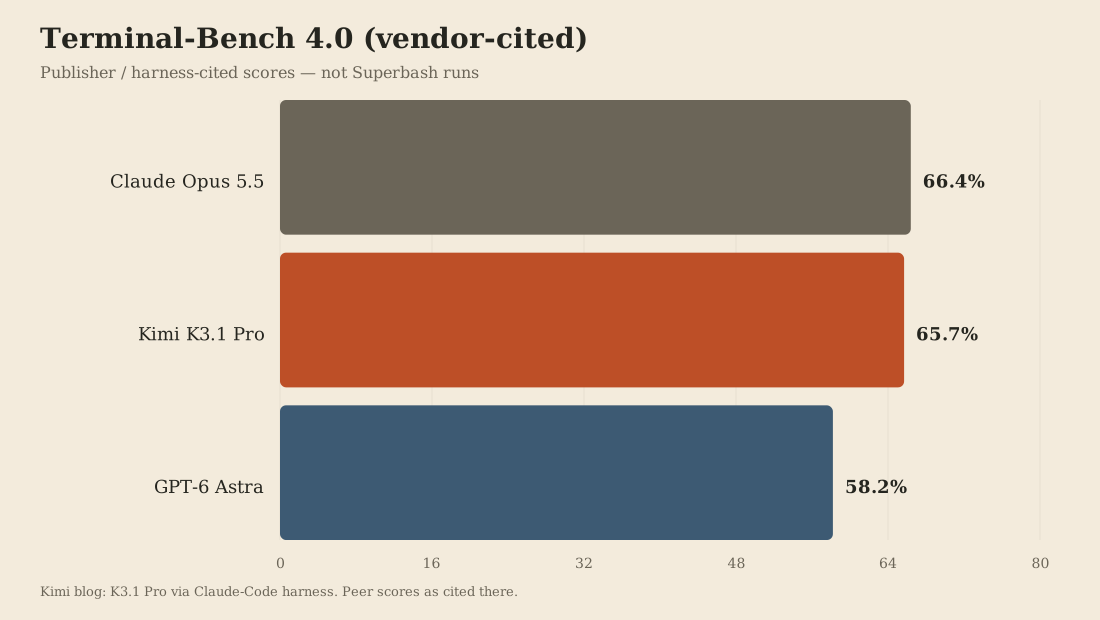
Moonshot’s launch gives this Terminal-Bench 4.0 snapshot. Kimi used the Claude Code harness; the peer figures are vendor-compiled and their conditions may differ.[1]
| Model, as cited by Moonshot | Terminal-Bench 4.0 |
|---|---|
| Kimi K3.1 Pro | 65.7% |
| Claude Opus 5.5 | 66.4% |
| GPT-6 Astra | 58.2% |
For BenchCAD with tools, the same launch publishes the following figures:[1]
| Model, as cited by Moonshot | BenchCAD with tools |
|---|---|
| Kimi K3.1 Pro | 92.7% |
| Claude Opus 5.5 | 96.2% |
| GPT-6 Astra | 95.9% |
These are useful leads for an evaluation shortlist. They do not resolve which model best preserves your repository constraints, produces usable CAD output, or needs less review. The publication is the evidence source; we have not rerun its harnesses.
Open weights and cyber controls
Moonshot describes removing cyber-related mid-training and reinforcement-learning data for the intended open-weight release. It also says general coding improvements can raise cyber capability even after that removal.[1]
| Vendor internal xdev-bench-hard variant | pass@3 |
|---|---|
| Without cyber-data removal | 90.5% |
| After cyber-data removal | 81.0% |
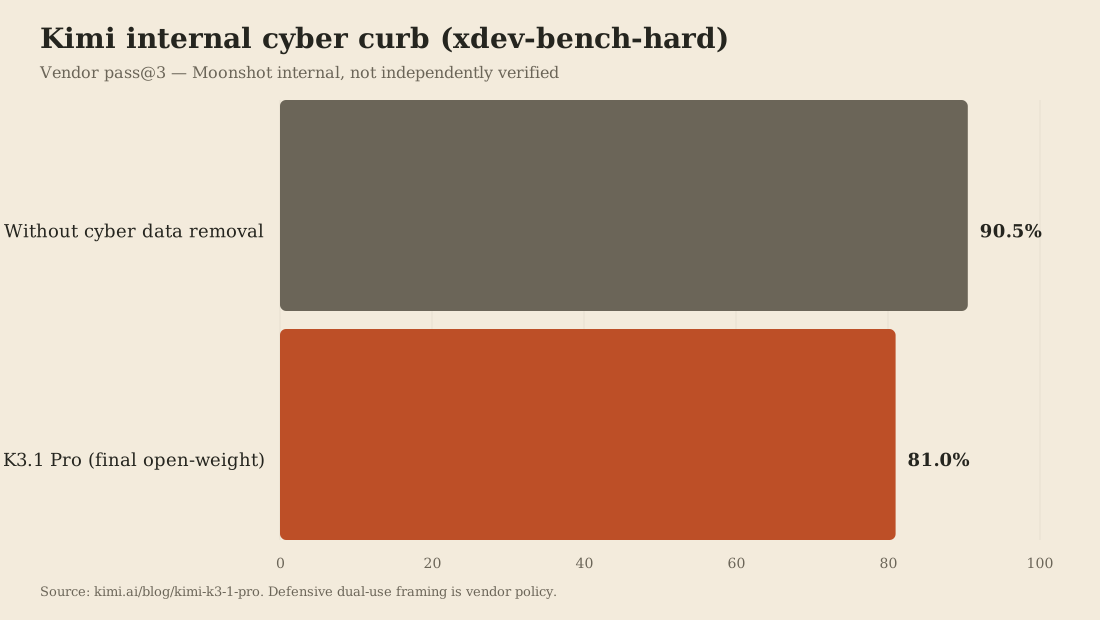
That ablation shows a difference in one internal test. It does not certify safety or show that cyber capability has disappeared. For a self-hosted deployment, wait for the actual weights, read their final license, and validate the deployment and controls separately. We make no hardware recommendation for this unreleased artifact.
How to try it in an agent stack
The following is a suggested future evaluation, not a completed run. Pin kimi-k3.1-pro, record the provider version and date, and start one bounded coding task at reasoning_effort=high. Set a completion cap and write the acceptance rubric before the request. Include the files the agent may edit, the expected artifact, and the checks that make it acceptable.
Record token usage, elapsed time, retries, review effort, and correction time. Compare high with other effort settings only after the first accepted result gives you a useful baseline. Then consider Highspeed with the same input and rubric. Its higher list price is worthwhile only if the result and time savings justify it for your work.
For a lower-list-price alternative with different thinking controls and tool charges, see DeepSeek Flash-1017 and Search/Fetch pricing. Scores from the two vendors’ publications are not a controlled head-to-head.
What to do now
- Confirm account access, the exact model ID, thinking behavior, and your output cap.
- Choose standard Pro first, or document why the Highspeed premium matters for this task.
- Define acceptance, cost, and latency criteria; retain usage and correction records for each attempt.
- Verify the weights and final license when the scheduled release happens rather than planning from an assumed download.
Use the lesson on choosing a model by the job to turn the release announcement into a bounded buying decision.
Can I disable thinking?
No. The documentation says K3.1 Pro always thinks; reasoning_effort changes effort rather than disabling it.[2][3]
Does membership pay for API requests?
No. Product membership and API billing are separate.[5]
When are weights available, and is Highspeed equivalent?
Moonshot schedules full weights by November 4. Verify publication and licensing on release. Highspeed is presented as the speed SKU of the same Pro line, but identical workload outcomes and a 2–3× speedup have not been measured by Superbash.[1][5]
Sources
Sources checked October 25, 2026. Launch, API, thinking, and pricing pages were re-fetched for this article; lineage sources below are used only for lineage. No authenticated model request was made.
[1] https://www.kimi.ai/blog/kimi-k3-1-pro — Moonshot launch, vendor benchmarks, and scheduled weights
[2] https://platform.kimi.ai/docs/guide/kimi-k3-1-pro-quickstart — API IDs, access, serving constraints, and tool caveat
[3] https://platform.kimi.ai/docs/guide/use-thinking-models — Thinking and reasoning effort
[4] https://platform.kimi.ai/docs/pricing — Official API pricing index
[5] https://www.kimi.ai/resources/kimi-k3-1-pro-pricing — API rates and product membership
[6] https://www.kimi.ai/blog/kimi-k3 — Prior K3 lineage, as recorded in the October 25 research packet
[7] https://huggingface.co/moonshotai/Kimi-K3 — Prior K3 model card, as recorded in the October 25 research packet
Put this to work
Separate documented API constraints, vendor benchmarks, and evidence from your own agent workload.
Try
Pin the model ID and plan one bounded coding task at reasoning_effort=high before comparing effort settings.
Prove it worked
Record provider version, accepted output, usage, elapsed time, retries, and correction time against the same rubric.
Keep in view
- Use kimi-k3.1-pro or kimi-k3.1-pro-highspeed; thinking is always on.
- Standard Pro lists $2 input and $10 output per million tokens; Highspeed doubles those rates.
- Moonshot schedules full weights by November 4, 2026; benchmark figures are vendor-cited.