Product case study · September 1, 2026
TimesFM-3 forecasts many series at once — but its default weights are non-commercial
Google's 330M TimesFM-3 handles multivariate forecasting and covariates, but its default PyTorch weights are not licensed for commercial or production use.
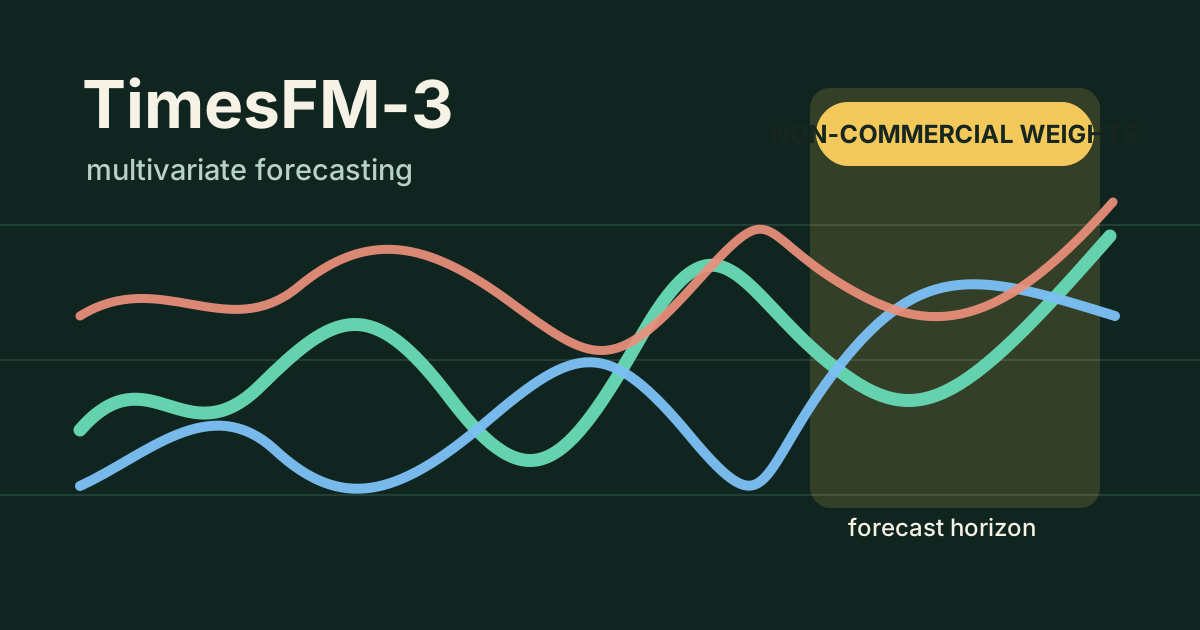
Evaluate TimesFM-3 only in a non-commercial, non-production setting until Google publishes a separately licensed route. Google reports strong public-benchmark ranks, while Superbash's fixed three-dataset run is explicitly unmeasured on this CPU-only worker.
The default TimesFM-3 weights are not licensed for commercial or production use. Google Research’s repository distinguishes its Apache-2.0 code from the timesfm-non-commercial-license-v1.0 on the v3 pretrained weights and says commercial or production use of those default weights is not permitted.[1] That restriction comes before any accuracy discussion: a technically attractive checkpoint is not an approved deployment route.
The exact release is google/timesfm-3.0-pytorch, a 330 million-parameter PyTorch checkpoint for time-series forecasting.[2] Google introduced it on August 31, 2026 as a zero-shot model that can jointly forecast multiple targets and accept past-only plus known-future covariates.[3] The release tag is v3.0.0 at commit 331c6d33cb1ac2611de3056d0ac7164aab6301eb.[4]
Access and license boundary
Hugging Face labels the checkpoint for time-series forecasting and lists the TimesFM Non-Commercial License v1.0.[2] At the September 1 check, its card also said that no Inference Provider deployed this model. That makes the checked route a local or self-managed evaluation, not a hosted commercial API.[2]
Do not collapse these facts into “Apache-2.0 weights.” The repository code is Apache-2.0, while the v3 pretrained weights are separately restricted.[1] Google also said BigQuery integration was forthcoming in its announcement; this page does not treat that as a live TimesFM-3 product route.[3]
What Google claims—and what Superbash measured
Google’s benchmark claims
Google says TimesFM-3 ranked first among pretrained foundation models on GIFT-Eval, FEV-Bench, and TIME under its own evaluation setup, and says multivariate mode improves its average rank when cross-series information and covariates are available.[3] The independent MarkTechPost launch coverage repeats the 330M, zero-shot multivariate description and the reported benchmark position.[5]
Those are vendor and launch-coverage claims, not a Superbash result. They do not establish accuracy on a particular retailer, telemetry system, or planning process.
Superbash evidence
The fixed TimesFM-3 benchmark packet defines three CC BY 4.0 UCI datasets, chronological held-out horizons, a seasonal-naive baseline, MAE, SMAPE, wall time, peak memory, raw-prediction paths, and an at-least-2-of-3 MAE gate. It is unmeasured: this worker has no NVIDIA GPU, only 7.5 GiB RAM, and no approved alternate accelerator. No checkpoint was downloaded and no predictions, metrics, plot, or performance result was manufactured.[6]
An unmeasured packet is not a failing score and is not evidence that TimesFM-3 loses to seasonal naive. It is a reproducible protocol plus a documented hardware limit.
The evaluation that remains
The protocol transforms public source data into three distinct forecasting scenarios: retail-like multivariate demand from Online Retail; monitoring-style hourly traffic telemetry from Metro Interstate Traffic Volume; and Bike Sharing, whose weather, calendar, and user-type columns provide known covariates.[6] Each source is CC BY 4.0 and remains outside this repository; the packet records attribution, download URLs, transformations, and frozen split rules.[6]
For every dataset, the runner must use the same context and held-out horizon for TimesFM-3 and a seasonal-naive forecast. It must retain raw forecasts and actuals, calculate MAE and SMAPE, record wall time and peak RSS, and reject invalid values. The pass gate is intentionally narrow: TimesFM-3 must beat seasonal naive on MAE in at least two of the three held-out datasets. A mixed or negative outcome remains publishable evidence.
If you have suitable approved hardware, use the pinned v3.0.0 code revision and checkpoint, run only the public data protocol in a non-commercial evaluation setting, and preserve failures. Do not transfer a vendor rank into a production recommendation, and do not convert the Apache-2.0 code license into permission to use the default v3 weights commercially.
Sources
[1] https://github.com/google-research/timesfm/tree/v3.0.0 — TimesFM v3.0.0 repository README and its explicit code-versus-weights license notice
[2] https://huggingface.co/google/timesfm-3.0-pytorch — checkpoint identity, model size, weight license, modality, and checked Inference Provider status
[3] https://research.google/blog/timesfm-3-a-zero-shot-foundation-model-for-multivariate-forecasting/ — Google Research announcement, capabilities, benchmark claims, and forthcoming BigQuery integration
[4] https://github.com/google-research/timesfm/releases/tag/v3.0.0 — v3.0.0 release and commit 331c6d33cb1ac2611de3056d0ac7164aab6301eb
[5] https://www.marktechpost.com/2026/08/31/google-ai-releases-timesfm-3-a-330m-parameter-zero-shot-foundation-model-for-multivariate-time-series-forecasting/ — independent launch coverage; not a Superbash measurement
[6] https://archive.ics.uci.edu/ — source licenses and dataset records are pinned in benchmarks/timesfm-3/sources/datasets.json
Put this to work
Separate Apache-2.0 repository code from the separate license on the v3 pretrained weights before evaluating a forecasting stack.
Try
Run the fixed public-data protocol in `benchmarks/timesfm-3/` only in a lawful non-commercial evaluation environment.
Prove it worked
Keep each chronological split immutable; retain raw predictions, MAE, SMAPE, wall time, peak memory, and failures alongside the seasonal-naive baseline.
Where it can pay
Do not use the default v3 weights in client or production forecasting without a separately permitted route.
Keep in view
- The exact checkpoint is `google/timesfm-3.0-pytorch`: 330M parameters for multivariate time-series forecasting.
- The v3 pretrained weights use TimesFM Non-Commercial License v1.0; Google says commercial and production use of the default weights is not permitted.
- At check time, Hugging Face listed no hosted Inference Provider for this checkpoint.