Case study · August 6, 2026
Where can I take my dog in Hong Kong? Building DogDogHK with AI
Dog owners needed a better way to find places to eat and go together. This is how AI helped us turn that narrow problem into a useful Hong Kong app.

Start with one problem people already have. DogDogHK helps Hong Kong dog owners decide where to go, while AI does the repetitive research needed to keep the choices useful.
Dog owners in Hong Kong keep running into the same question: where can I take my dog today?
The answer is scattered across government records, restaurant pages, social posts and old recommendations. Even when a place calls itself dog friendly, you still need to know whether your dog can sit inside, whether large dogs are welcome, how to get there and whether the information is current.
DogDogHK was built for that decision. It is a bilingual Hong Kong web app for finding dog-friendly restaurants, parks, malls and outings. Instead of starting with a broad idea about what AI could do, we started with a narrow audience and a problem that comes up whenever they plan an outing.
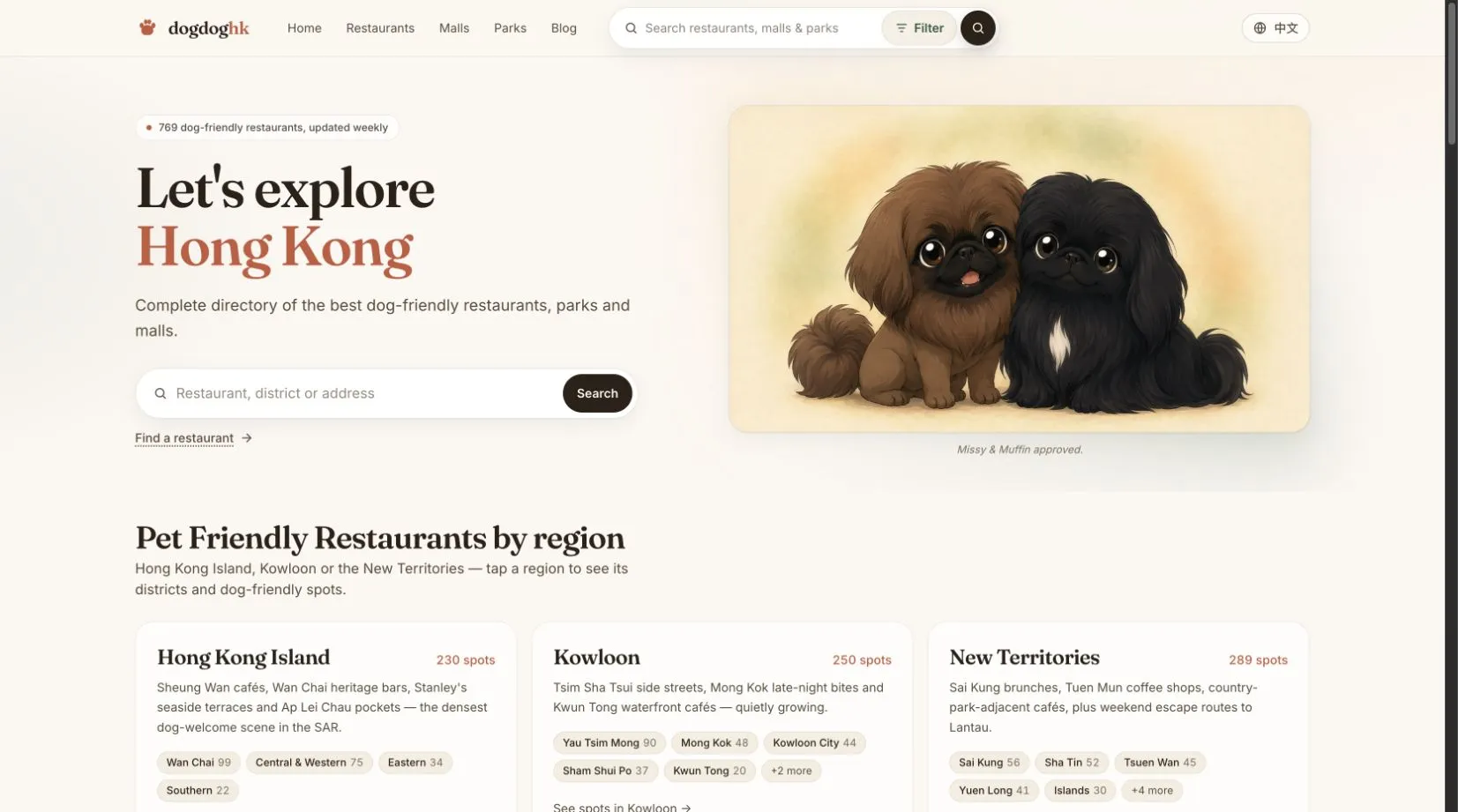
At the time of this case study, the app had 769 restaurant listings across Hong Kong Island, Kowloon and the New Territories. AI helped us build and maintain that coverage, but the product is the useful decision at the end: pick somewhere you can actually go with your dog.
Pick a niche with a real decision attached
“An app for dog lovers” is still too vague. A useful niche product needs to help someone do something.
DogDogHK focuses on a clear job: help a dog owner choose a place and plan the visit. That immediately tells us what belongs in the product. People need to browse by area, see what a venue offers, check the dog policy, work out transport and confirm the details before leaving home.
This focus also stops the project from becoming a generic pet-content site. A visitor does not need another article saying Hong Kong has many lovely places for dogs. They need a shortlist that fits today’s outing.
Turn existing information into a product
Hong Kong’s Food and Environmental Hygiene Department (FEHD) already publishes a list of food premises permitted to admit dogs. It answers the legal question, but it was not designed to help someone choose lunch.
A government row may contain a trading name, licence number, district and address. A dog owner needs more context: cuisine, price, photos, booking details, transport, seating and the venue’s current dog policy. DogDogHK turns the official list into pages people can search and use.
The official register gives the app a trustworthy starting point. We keep the FEHD licence attached to each listing and add information from OpenRice, venue pages, social sources and community reports where it can be matched confidently.
That division of labour is important. FEHD decides which restaurants are legally registered. AI helps turn the source material into something a dog owner can act on.
Use AI to do the repetitive work
Building one restaurant page by hand is manageable. Researching hundreds of them, in English and Traditional Chinese, is where the work becomes expensive.
We used Loops to organise the repeated research. Small batches of restaurant records went through the same process: find the likely venue, check the address, collect useful details, flag uncertainty and return structured data for review.
The agent was not asked to write 769 glowing restaurant profiles. It had a narrow job and a fixed set of fields. Missing information could stay missing. A weak match could fail. That made the output much easier to review and publish.
The working loop looked like this:
- Read active restaurant records that still need enrichment.
- Split them into small JSON chunks.
- Research each venue against OpenRice and other available sources.
- Return structured fields plus notes about ambiguous or failed matches.
- Validate the result files before merging them into the public dataset.
AI reduced the repetitive work without taking over the product decisions. We still chose what information mattered, what counted as a match and what was safe to show to visitors.
Build around the questions users ask
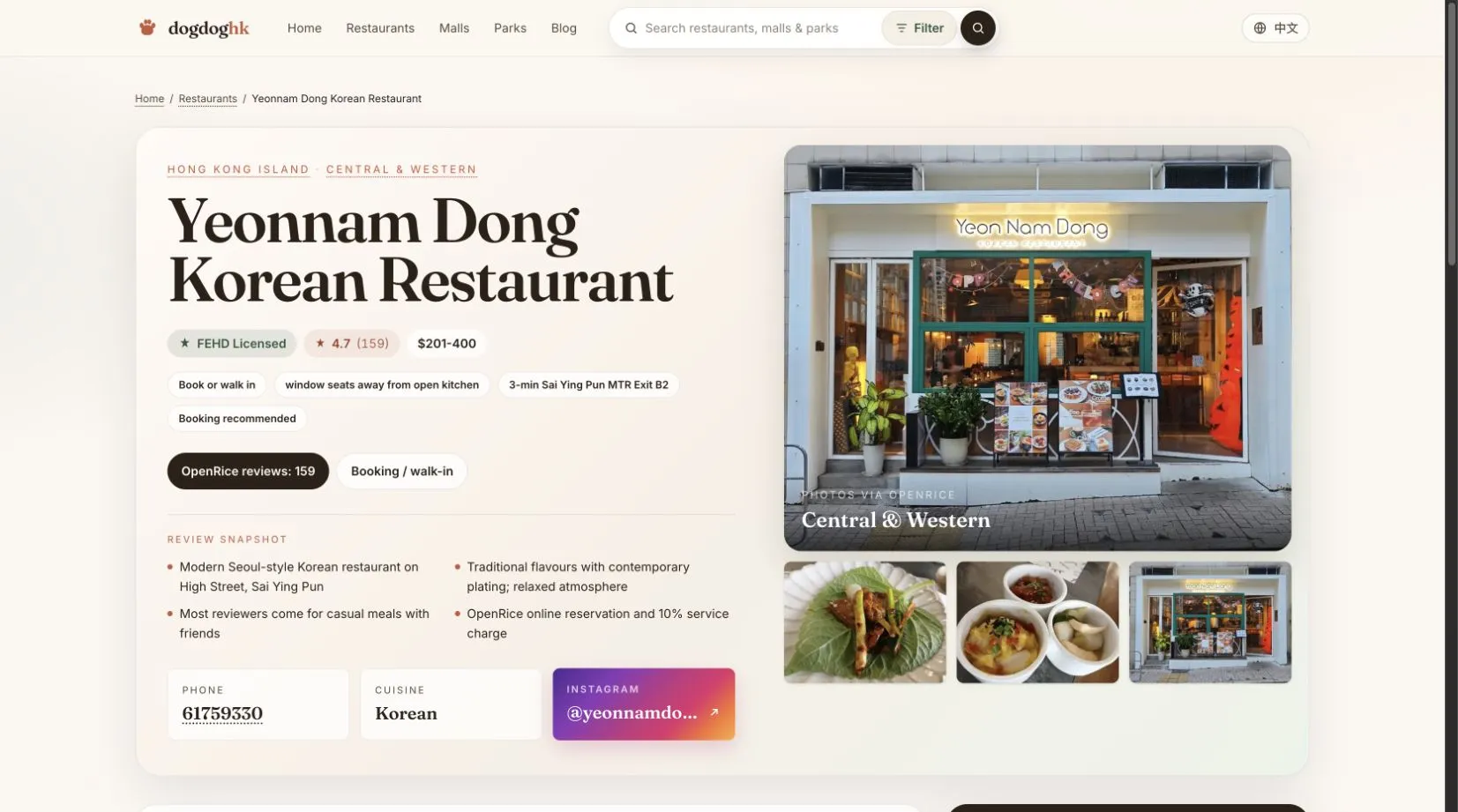
Every extra field should help someone decide whether to go. Depending on the available evidence, a DogDogHK restaurant page can include:
- its OpenRice page, rating, review count, cuisine, price range and photos;
- phone, booking route and practical walk-in guidance;
- seating details, dog size policy and documented amenities;
- MTR access, step-free access and nearby parking;
- venue Instagram, Google data and official website links;
- community-reported details and photos from Facebook groups or real visits.
That information turns “dog friendly” into a plan. Can my dog sit inside? Is this suitable for a large dog? Do I need to book? Which MTR exit should I use? Is there parking nearby?
DogDogHK also supports discovery beyond restaurants. The same product idea extends to parks, malls and dog-friendly outings because the user need stays the same: help me choose where to go with my dog.
Trust matters when people leave home
Wrong information does more than make a page look bad. It can waste a trip or put a dog owner in an awkward argument at the door.
That is why matching is strict. A similar restaurant name is not enough. The address must align with the FEHD record, and uncertain fields stay empty. If the research cannot find a confident match, the app records the failure instead of attaching a convenient but wrong page, phone number or set of photos.
Venue rules can change, and community reports can go stale. DogDogHK keeps source links visible, labels community evidence and recommends calling ahead when the policy matters. English and Traditional Chinese pages use the same venue record so both audiences receive the same underlying information.
What made this a product instead of an AI demo
Generating pages is easy. Shipping a useful niche app means making choices about the audience, the decision they need to make and the information they can trust.
DogDogHK works because each part serves the outing:
- the homepage starts with regions and ways to explore;
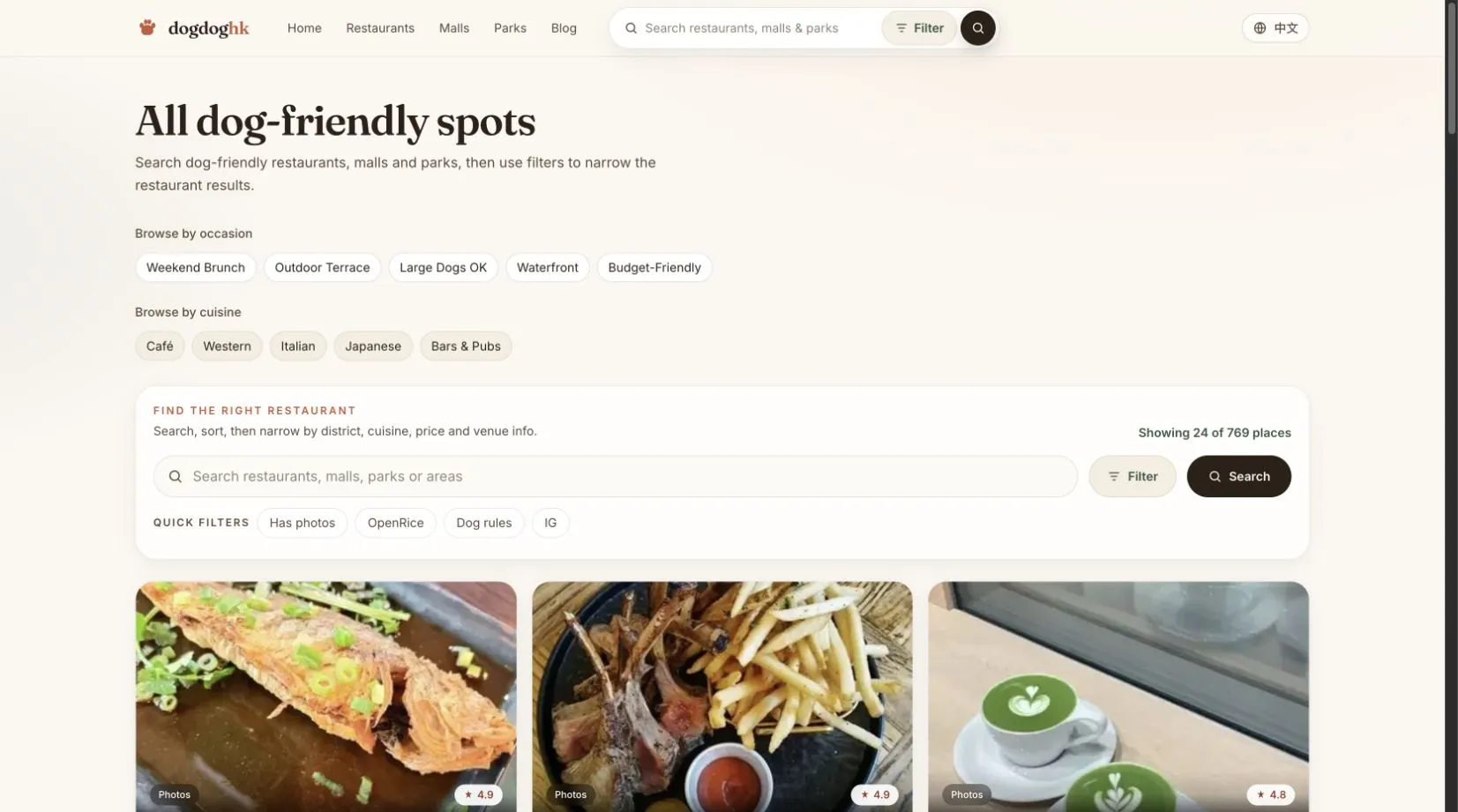
- the browser helps people narrow hundreds of choices;
- detail pages answer practical questions before a visit;
- bilingual routes serve Hong Kong users in English and Traditional Chinese;
- visible sources show where the information came from;
- guides to parks, malls and outings expand the same core use case.
The AI work sits behind that experience. One reviewed restaurant record can feed the browser, district pages, filters, bilingual detail routes, structured data and related guides. Reusable data lets the product grow without rewriting the same facts on every page.
A repeatable playbook for a niche AI app
The DogDogHK build suggests a practical sequence for other niche products:
- Choose a specific group of people.
- Identify a decision they make repeatedly.
- Find trustworthy information that can anchor the product.
- Use AI for the repetitive research and transformation work.
- Keep uncertain results out of the published experience.
- Design every page around helping the user finish the decision.
A narrow audience is an advantage. You do not need to build everything for every dog owner. Solve one recurring Hong Kong problem well enough that people come back the next time they plan an outing.
Test whether the useful product can become a business
A working directory is not proof that anyone will pay. The first commercial question is who receives enough value to fund the work. A venue may value a qualified booking or a better listing. A dog owner may value a trusted guide. Another local publisher may need structured research and bilingual enrichment.
Those are hypotheses. DogDogHK does not need to pretend they are current revenue. A responsible test would show a venue the existing product, offer one clearly labelled placement or research service, and ask for a small commitment before building a large sales or billing system. Track whether owners reply, whether visitors use the promoted route, and whether the work takes less to deliver than it earns.
For a seven-day learner project:
- Interview three people in one narrow community about a repeated decision.
- Manually create five records from a trustworthy source.
- Ask one person to use them for a real decision and watch where they get stuck.
- Improve the fields and evidence before adding AI automation.
- Ask three potential buyers what result they would pay for. Record the answer without pitching a guaranteed outcome.
The goal for week one is not passive income. It is one useful result, one real user, and one piece of evidence about who might pay.
Continue with the niche directory guide and the small operator’s online business stack.
The product keeps improving
DogDogHK is a living directory. Restaurants close, policies change and community knowledge improves over time. The same AI-assisted loop that helped build the first useful version can research updates and prepare them for review.
Visit DogDogHK when you need somewhere to take your dog in Hong Kong. You can also read the latest dog-friendly guides or browse the English restaurant directory.
Disclosure and sources
DogDogHK is one of our own projects. The account of how Loops was used comes from the project maintainer; the current page count, screenshots and implementation details were checked against the live site and local project files on August 6, 2026.
Put this to work
Turn scattered public information into a reviewed, searchable product for a specific community.
Try
Choose one local niche, interview three potential users, and manually produce five useful records before automating collection.
Prove it worked
Show that a real user can make a decision from the records, then track corrections, repeat visits, or requests for more coverage.
Where it can pay
After people use it, test one offer such as sponsored placement, qualified leads, or a research service. These are hypotheses, not claims about DogDogHK revenue.
Keep in view
- Start with one repeated local decision, not a broad idea for an AI app.
- Anchor the product in a trustworthy dataset, then use AI for bounded research and transformation.
- Keep uncertain matches out of production and design every field around a question the user needs answered.