Product case study · September 1, 2026
DeepSeek V4 Flash Vision Exp is multimodal, open-weight, and not readiness-tested
DeepSeek calls this its first experimental multimodal V4 model. The MIT weights are public, but our nine-run practical benchmark remains unmeasured.
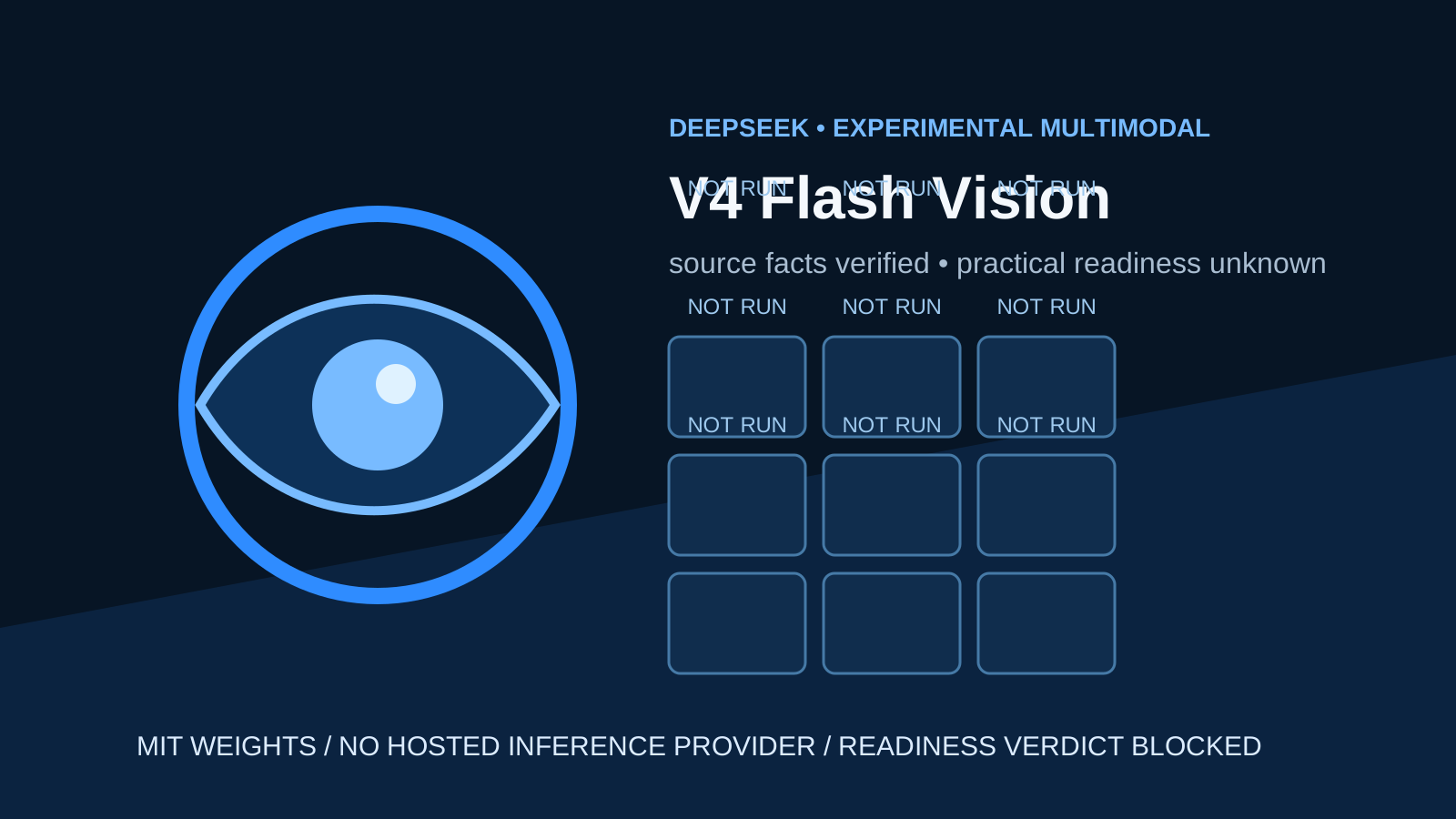
Treat DeepSeek V4 Flash Vision Exp as a research candidate, not a production recommendation. Its identity, MIT license, pipeline, repository size, and parameter count are sourced; access, limits, cost, hardware needs, and practical performance remain unknown or unmeasured.
DeepSeek calls deepseek-ai/DeepSeek-V4-Flash-Vision-Exp the first experimental multimodal model in the DeepSeek-V4 series.[1] That wording is a publisher claim, not an independent finding. The repository is nevertheless concrete evidence that a multimodal checkpoint exists: Hugging Face labels its pipeline image-text-to-text and records the license as MIT.[1][2]
What the primary sources establish
The Hugging Face API record reports 304,646,824,126 parameters and 167,819,616,863 bytes of used storage.[2] At this page’s September 1, 2026 check it gave revision SHA 31ea11185e11ccafad1c385104188a9e3b648ad6, with creation dated August 31, 2026 and last modification dated September 1, 2026.[2] These are repository metadata, not claims about active parameters, memory consumption, inference speed, or minimum hardware.
The model card describes the release as experimental and multimodal.[1] We preserve that scope: this page does not infer a production support level from the pipeline tag, and it does not turn DeepSeek’s own examples or evaluations into independent benchmark results.
What remains unknown
At check time, Hugging Face stated that the model was not deployed by an Inference Provider.[1] No other lawful compatible route was approved for this task, and no approved hardware was available. Accordingly, we do not claim a hosted API, price, context window, output limit, minimum GPU configuration, latency, throughput, or cost per accepted result.
The repository size is also not a hardware prescription. Quantization, runtime support, memory overhead, parallelism, image preprocessing, and usable sequence length all affect a real deployment. Those variables need a documented serving setup and an actual run.
The reproducible benchmark is unmeasured
The dossier in benchmarks/deepseek-v4-flash-vision-exp/ fixes three multimodal tasks using original MIT-licensed repository fixtures: chart-to-structured-JSON extraction, screenshot-guided UI bug localization, and image-plus-repository change planning. The third task pairs a synthetic target screenshot with a small benign TSX source fixture and requires a plan grounded in both. Each task has one prompt and rubric and is scheduled for three independent runs under a pinned configuration.[unverified]
All nine raw result entries say not_run; raw output, timing, token, cost, environment, review, and result fields are null rather than zero.[unverified] The reason is access, not model quality: there was no lawful compatible hosted route and no approved hardware, so no weights were downloaded and no inference was attempted.[unverified]
The gate is deliberately resistant to one lucky output. A task passes only when at least two of its three runs are accepted against its rubric. A practical-readiness verdict requires at least two of the three tasks to pass. Because zero runs exist, the conclusion is no practical readiness verdict—blocked pending real runs.[unverified]
Sources
[1] https://huggingface.co/deepseek-ai/DeepSeek-V4-Flash-Vision-Exp — DeepSeek model card and Hugging Face deployment status
[2] https://huggingface.co/api/models/deepseek-ai/DeepSeek-V4-Flash-Vision-Exp — Hugging Face model API metadata
Put this to work
Keep publisher claims, repository metadata, and independently reproduced task results in separate evidence buckets.
Try
Run the public SVG fixture packet only after lawful compatible access or approved hardware exists.
Prove it worked
Require two accepted runs out of three for a task, then two passing tasks out of three before making a readiness verdict.
Where it can pay
Do not estimate deployment economics until route, hardware, latency, usage, and correction time are measured.
Keep in view
- DeepSeek describes this as the first experimental multimodal DeepSeek-V4 model.
- Hugging Face reports 304,646,824,126 parameters, 167,819,616,863 bytes of used storage, an MIT license, and the image-text-to-text pipeline.
- No Hugging Face Inference Provider deployment was listed, so the fixed three-task, nine-run dossier is explicitly unmeasured.