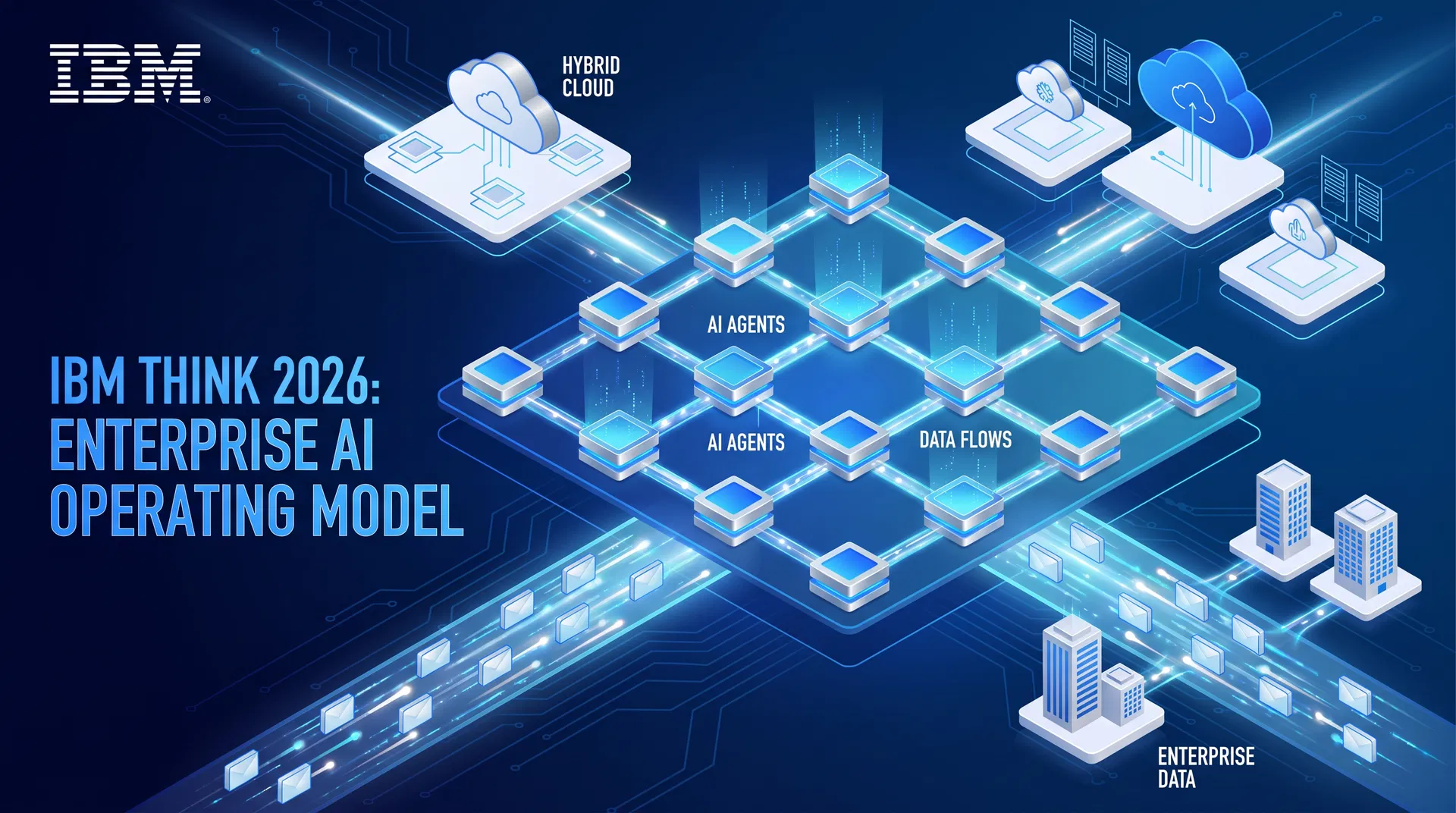
IBM used its annual Think conference on May 5, 2026 to articulate what it calls the AI Operating Model — a framework for how enterprises should integrate artificial intelligence not as a collection of point solutions, but as a fundamental redesign of how the business operates. The announcements represent IBM's most comprehensive expansion of enterprise AI and hybrid cloud management capabilities to date, addressing what CEO Arvind Krishna described as the defining challenge facing enterprises: many have invested heavily in AI, but only few believe it is paying off.
"The enterprises pulling ahead are not deploying more AI — they're redesigning how their business operates. Running AI in the enterprise requires a new operating model."
— Arvind Krishna, Chairman and CEO, IBMThe Four Pillars: Agents, Data, Automation, Hybrid
IBM's AI Operating Model rests on four integrated systems working in concert. The first is agents — coordinated AI that executes and adapts across the business. The second is data — real-time, connected information that gives teams a shared view of operational state. The third is automation — end-to-end infrastructure and automated workflows that scale across processes. The fourth is hybrid — operational independence for sovereignty, governance, and security that allows AI to run consistently with appropriate controls. IBM's argument is that enterprises pursuing these as separate priorities will fail to capture the compounding value that emerges when all four work together.
watsonx Orchestrate: The Agentic Control Plane
The centerpiece announcement is the next generation of watsonx Orchestrate, available in private preview, which IBM is repositioning as an agentic control plane for the multi-agent era. As organizations move from deploying a handful of agents to managing thousands — built by different teams on different platforms — the core challenge shifts from building agents to keeping them governed and auditable in near real time. The new Orchestrate addresses this by enabling organizations to deploy agents from any source with consistent policy enforcement and accountability, regardless of which underlying model or framework the agent was built on.
Alongside Orchestrate, IBM announced the general availability of IBM Bob, an agentic development partner designed specifically for enterprise environments. Bob partners with developers to build agents with security and cost controls built in from the start — a direct response to the governance failures that have plagued early enterprise AI deployments, where agents built for speed often lacked the auditability and cost controls that enterprise IT and compliance teams require.
Real-Time Data Foundation via Confluent
IBM's recent acquisition of Confluent, the real-time data streaming platform built on Apache Kafka and Flink, is central to the data pillar of the operating model. For most enterprises, data is siloed and without semantic meaning — a fundamental barrier to effective agentic AI, which requires up-to-date, contextually rich information to act reliably. IBM is pairing Confluent's real-time streaming capabilities with new watsonx.data features, including a real-time context layer for AI that applies semantic meaning to enterprise data, enforces governance at runtime, and makes AI decisions explainable.
A proof of concept with Nestle demonstrated the potential scale of the efficiency gains. Using watsonx.data's GPU-accelerated Presto engine, IBM achieved an 83% cost reduction and an overall 30x price-performance improvement on a global data mart spanning 186 countries. While proof-of-concept results rarely translate directly to production environments, the Nestle benchmark provides a concrete reference point for the magnitude of efficiency gains that IBM's data infrastructure is targeting.
IBM Concert: Intelligent Infrastructure Operations
The automation pillar is anchored by IBM Concert, an AI-powered operations platform now available in public preview. Concert addresses the fragmentation problem that plagues enterprise infrastructure management: most organizations are managing complexity through fragmented tools, siloed teams, and humans serving as the connective layer between systems that were never designed to work together. Concert correlates signals across applications, infrastructure, and network into a single view, without requiring organizations to replace existing tooling.
IBM also announced Concert Secure Coder, which embeds security management directly into the developer workflow. Available in both IBM Bob and VS Code, it identifies and prioritizes security risks as code is written, and can generate automatic remediations to fix vulnerable code or patch OS, middleware, packages, and container images. The timing is notable: IBM's own security research has documented that AI-assisted cyberattacks are now capable of identifying and exploiting vulnerabilities in hours rather than days, making proactive security embedding a competitive necessity rather than a best practice.
The Governance and Sovereignty Layer
Completing the operating model is IBM Sovereign Core, which provides operational independence for enterprises that need to run AI with strict data residency, regulatory compliance, or security isolation requirements. IBM Vault 2.0, also announced at Think, introduces AI-driven analysis of leaked secrets for rapid triage, dynamic short-lived credentials across major cloud providers, and automated secrets rotation to reduce credential sprawl — a direct response to the growing credential management challenges created by agentic AI systems that require access to multiple enterprise systems.
The cumulative picture IBM is painting at Think 2026 is of an enterprise AI market that is maturing past the pilot stage. The question is no longer whether AI can perform useful tasks in isolation, but whether it can be governed, audited, and integrated into the operational fabric of large organizations at scale. IBM's bet is that the enterprises willing to redesign their operating model around AI — rather than simply adding AI capabilities to existing processes — will capture disproportionate value in the coming years.