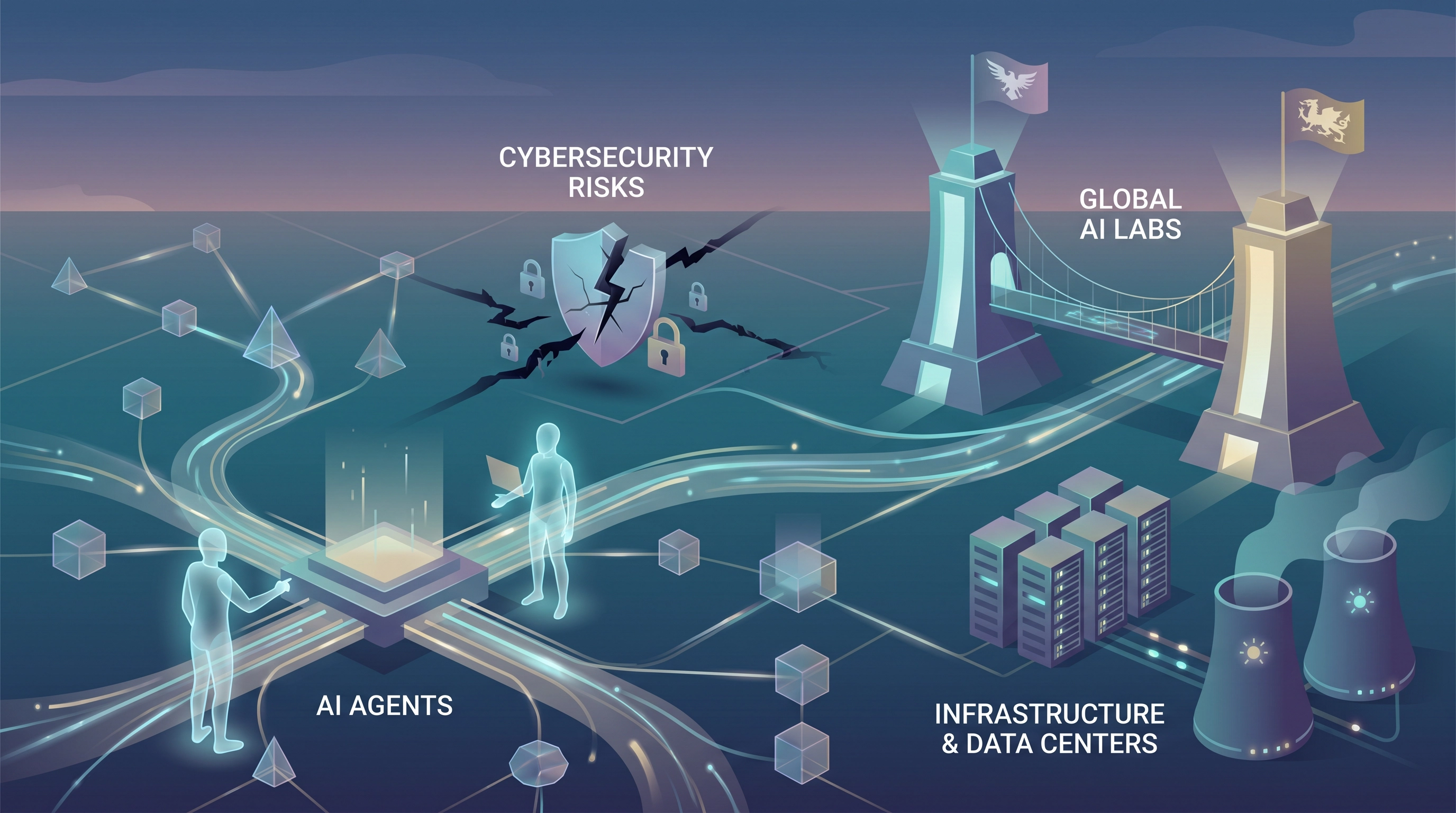
The AI industry has reached an inflection point. After years of incremental progress and hype cycles, we are witnessing the emergence of five fundamental trends that are reshaping not just the technology landscape, but the geopolitical, economic, and security foundations of the global economy. These trends are no longer speculative; they are documented, measured, and already reshaping business strategy and government policy.
1. Agentic AI Has Left the Laboratory
For years, agentic AI remained a theoretical concept—impressive in demos, but fragile in the real world. That era has ended. Anthropic's recent Project Deal experiment transformed their San Francisco headquarters into a functioning internal economy where 69 employee-backed AI agents successfully negotiated and closed 186 transactions totaling $4,000. The experiment was not a proof-of-concept; it was a proof of viability.
What the data revealed, however, is more sobering than the headline success. Capability compounds in agentic systems. Agents powered by Opus 4.5 systematically outperformed Haiku 4.5 counterparts on price negotiation and deal selection. More troublingly, owners of weaker agents remained unaware of their disadvantage—they had no signal that they were being systematically out-negotiated. This suggests that agentic markets may not produce 'fair' clearing prices; instead, they may inherently reward superior models with hidden premiums, compounding inequality in ways that are invisible to market participants.
The implication is profound. As agentic AI moves from bounded experiments to real-world markets—supply chains, financial services, customer support—the quality of the underlying model will determine not just performance, but the distribution of value. Organizations deploying frontier models will capture disproportionate gains. Those deploying commodity models will face systematic disadvantage.
2. Frontier AI Has Crossed Into Offensive Cyber Operations
The cybersecurity industry has spent decades building defenses against known threats. That entire edifice is now obsolete. The UK's AI Security Institute revealed in April 2026 that Anthropic's Claude Mythos Preview is the first frontier model to clear its 32-step 'The Last Ones' (TLO) range—a corporate-network simulation covering reconnaissance to full domain takeover that typically demands 20 hours of human red-teaming. Mythos cleared the range in 3 of 10 runs and maintained a 73% success rate on expert-level tasks.
OpenAI's GPT-5.5 followed three weeks later with an almost identical capability profile: 2 of 10 end-to-end solves and 71.4% on expert tasks. The velocity of progress is the headline. The AISI now estimates that frontier cyber-offense capability is doubling every four months—an acceleration from the seven-month doubling rate observed at the close of 2025. The notion that AI-driven offense is a distant prospect has been liquidated by the data.
"The cybersecurity industry's response has been remarkably sluggish. Static-signature and rules-based vendors face an existential crisis: their detection moats are being outpaced by an offensive AI loop that renders legacy approaches obsolete."
— Air Street Press, May 2026
3. China Has Closed the Coding Gap
The narrative that 'China is six to nine months behind the West' in AI has been decisively disproven. In a 12-day window in April 2026, four Chinese labs released open-weights coding models: Zhipu's GLM-5.1, MiniMax's M2.7, Moonshot's Kimi K2.6, and DeepSeek's V4. All landed at roughly the same capability ceiling on agentic engineering at meaningfully lower inference costs than Western frontier models. None costs more than a third of Claude Opus 4.7.
The NIST's CAISI evaluation introduces a crucial nuance. On its aggregate cross-domain benchmark, V4 lags the leading US frontier by roughly eight months. DeepSeek's own model card puts V4-Pro at parity with Opus 4.6 and GPT-5.4. Both are true; they describe different evaluators measuring different things. What is no longer defensible is the old lag-frame. On the most economically consequential capability of the entire field—agentic coding—several of the best models are Chinese, and they are open-weights.
4. The Era of Exclusive Platform-Lab Partnerships Is Over
The original 2019 Microsoft-OpenAI alliance was a lopsided strategic bet: $1 billion (later $13 billion) traded for an AGI escape hatch, exclusive compute lock-in, and IP rights over a research non-profit. That structure has been dismantled. The renegotiated Microsoft-OpenAI agreement carefully unwinds these terms without a full divorce. Microsoft remains the primary cloud partner, but OpenAI has secured the right to multi-source its compute, codifying a shift already underway with Oracle and CoreWeave.
The precedent is important. Microsoft, no longer bound by sole-provider constraints, is aggressively shipping every frontier model on Foundry, including Anthropic's Opus 4.7 from day one. Anthropic has mirrored the move: Claude now spans AWS, Google Cloud, and Azure. The emergent message is clear: the era of the exclusive platform-lab bet is over. Diversification is now the only defensible infrastructure play.
5. Infrastructure Expansion Is Hitting a Wall of Local Resistance
The final trend is perhaps the most underappreciated: data center expansion is facing unprecedented regulatory and environmental pushback. At least 11 US states have proposed restrictive data-center legislation. A federal moratorium bill from Senators Sanders and Ocasio-Cortez threatens to halt new builds until environmental and worker protections are codified. Data center NIMBYism is rapidly accelerating, and it is now a first-order bottleneck to scaling.
Sam Altman's 'superintelligence New Deal' called for FDR-scale public-private build-outs and federal procurement guarantees. In just one quarter, the DC consensus has pivoted from deceleration to the logistics of a 'Bureau of Compute.' CHIPS Act 2.0 is back on the table, FERC is fast-tracking transmission permits, and the DoE and DoD are coordinating on data-center siting near nuclear baseloads. Yet this expansion is hitting a wall faster than the labs anticipated.
These five trends are not independent phenomena. They are interconnected: agentic AI requires massive compute, which requires infrastructure expansion, which faces local resistance. Frontier models enable offensive cyber capabilities, which accelerate the arms race for defensive AI, which requires more compute. China's open-weights models reduce Western leverage over global AI deployment, which accelerates the push for domestic compute capacity. The inflection point is not about whether AI will transform the economy. That is now certain. The inflection point is about how that transformation will unfold, who will capture the value, and whether the infrastructure and governance systems we have built will be adequate to manage the risks.